If a $30\, V$, $90\, W$ bulb is to be worked on a $120\, V$ line, a resistance of how many ohms should be connected in series with the bulb ............... $ohm$
Medium
Download our app for free and get started
(c) Suppose resistance $R$ is corrected in series with bulb. Current through the bulb $i = \frac{{90}}{{30}} = 3\,A$
Hence for resistance $V = i\,R$$ \Rightarrow $ $90 = 3 \times R \Rightarrow R = 30\,\Omega $
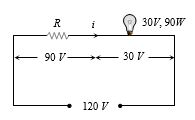
Hence for resistance $V = i\,R$$ \Rightarrow $ $90 = 3 \times R \Rightarrow R = 30\,\Omega $

Download our appand get started for free
Experience the future of education. Simply download our apps or reach out to us for more information. Let's shape the future of learning together!No signup needed.*
Similar Questions
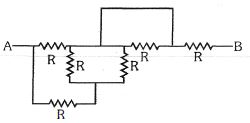
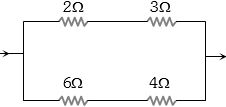
- 1What is the equivalent resistance between $A$ and $B$View Solution
- 2View SolutionAcross a metallic conductor of non-uniform cross section a constant potential difference is applied. The quantity which remains constant along the conductor is
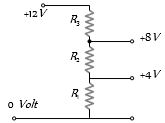
- 3A potential divider is used to give outputs of $4\, V$ and $8\, V$ from a $12\, V$ source. Which combination of resistances, $(R_1, R_2, R_3)$ gives the correct voltages ? $R_1 : R_2 : R_3$View Solution
- 4View SolutionThe equivalent resistance of resistors connected in series is always
- 5A uniform wire of resistance $R$ is uniformly compressed along its length, until its radius becomes $n$ times the original radius. Now resistance of the wire becomesView Solution
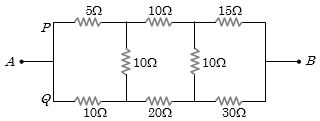
- 6In the arrangement of resistances shown below, the effective resistance between points $A$ and $B$ is ............... $\Omega$View Solution
- 7In the circuit as shown in the figure, the heat produced by $6\, ohm$ resistance due to current flowing in it is $60$ calorie per second. The heat generated across $3\, ohm$ resistance per second will be ................. $calorie$View Solution
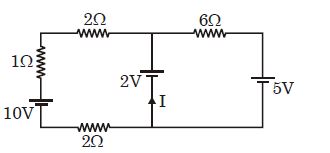
- 8Find the value of $I$ ?................ $\mathrm{A}$View Solution
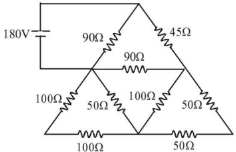
- 9In the circuit shown in the figure, find the current in $45\, \Omega$ $..........\,A$View Solution
- 10In a meter bridge experiment null point is obtained at $20\, cm$ from one end of the wire when resistance $X$ is balanced against another resistance $Y$. If $X < Y$, then where will be the new position of the null point from the same end, if one decides to balance a resistance of $4X$ against $Y$ ........... $cm$View Solution