MCQ
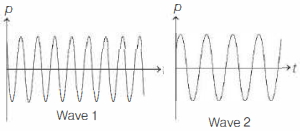
The figure below shows pressure variation in two different sound waves in air with time at a given position. Both the figures are drawn to the same scale. Which of the following statements is true?
  • A
    Wave $1$ has lower frequency and smaller amplitude compared to wave $2$
  • B
    Wave $1$ has higher frequency and greater amplitude compared to wave $2$
  • C
    Wave $1$ has shorter wavelength and greater amplitude compared to wave $2$
  • Wave $1$ has shorter wavelength and smaller amplitude compared to wave $2$
Answer

Correct option: D.
Wave $1$ has shorter wavelength and smaller amplitude compared to wave $2$
d
(d)

As,

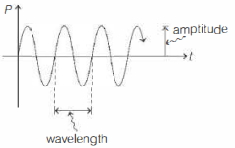
Amplitude $\propto$ Maximum pressure and Wavelength $\propto$ Time duration for $1$ complete variation

So, wave $1$ has shorter wavelength and smaller amplitude compared to wave $2 .$

Need a full question paper?

Generate a complete, print-ready paper with questions like this in minutes — across 16+ boards, with answer keys.

Start Generating Free

Similar questions

Two straight metallic strips each of thickness $t$ and length $\ell$ are rivetted together. Their coefficients of linear expansions are $\alpha_1$ and $\alpha_2$. If they are heated through temperature $\Delta T$, the bimetallic strip will bend to form an arc of radius
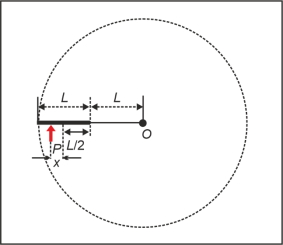
A thin uniform rod of length $L$ and certain mass is kept on a frictionless horizontal table with a massless string of length $L$ fixed to one end (top view is shown in the figure). The other end of the string is pivoted to a point $O$. If a horizontal impulse $P$ is imparted to the rod at a distance $x=L / n$ from the mid-point of the rod (see figure), then the rod and string revolve together around the point $O$, with the rod remaining aligned with the string. In such a case, the value of $n$ is. . . . . . 
The equation of a certain gas can be written as: ${\left( {\frac{{{T^7}}}{{{P^2}}}} \right)^{1/5}} = $ constant. The specific heat at constant volume of this gas is in $\left( {in\frac{J}{{mol\,K}}} \right)$
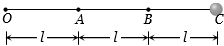
Three identical particles are joined together by a thread as shown in figure. All the three particles are moving in a horizontal plane. If the velocity of the outermost particle is $v_0$, then the ratio of tensions in the three sections of the string is
The horizontal range and maximum height attained by a projectile are $R$ and $H$, respectively. If a constant horizontal acceleration $a=g / 4$ is imparted to the projectile due to wind, then its horizontal range and maximum height will be
A hydrogen atom in ground state absorbs $10.2 eV$ of energy. The orbital angular momentum of the electron is increased by:
 
A body of mass $3\, kg$ is under a constant force which causes a displacement $s$ in metres in it, given by the relation $s=$$\frac{1}{3}{t^2}$ , where $t$ is in seconds. Work done by the force in $2$ seconds is
The weight of sphere in air is $50\ g$. Its weight $40\  g$ in a liquid, at temperature $20\,^o C$. When  temperature increases to $70\,^o C$ , it weight becomes $45\  g$, then the ratio of densities of liquid at given two temperature is
A plane is revolving around the earth with a speed of $100\, km/hr $ at a constant height from the surface of earth. The change in the velocity as it travels half circle is.........$km/hr$
A particle moves such that its position vector $\overrightarrow{\mathrm{r}}(\mathrm{t})=\cos \omega \mathrm{t} \hat{\mathrm{i}}+\sin \omega \mathrm{t} \hat{\mathrm{j}}$ where $\omega$ is a constant and $t$ is time. Then which of the following statements is true for the velocity $\overrightarrow{\mathrm{v}}(\mathrm{t})$ and acceleration $\overrightarrow{\mathrm{a}}(\mathrm{t})$ of the particle