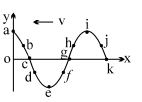
The figure represents the instantaneous picture of a longitudinal harmonic wave travelling along the negative $x$-axis. Identify the correct statement $(s)$ related to the movement of the points shown in the figure. The maximum displaced points are
Diffcult


Download our appand get started for free
Experience the future of education. Simply download our apps or reach out to us for more information. Let's shape the future of learning together!No signup needed.*
Similar Questions
- 1A closed pipe of length $10 \,cm$ has its fundamental frequency half that of the second overtone of an open pipe. The length of the open pipe ......... $cm$View Solution
- 2A plane wave is represented by $x = 1.2\sin (314\,t + 12.56y)$Where $x$ and $y$ are distances measured along in $x$ and $y$ direction in meters and $t$ is time in seconds. This wave hasView Solution
- 3View SolutionSound waves of wavelength greater than that of audible sound are called
- 4In an experiment with sonometer a tuning fork of frequency $256 Hz$ resonates with a length of $25 cm$ and another tuning fork resonates with a length of $16 cm$. Tension of the string remaining constant the frequency of the second tuning fork is .... $Hz$View Solution
- 5An open organ pipe of length $l$ is sounded together with another organ pipe of length $l + x$ in their fundamental tones $(x < < l)$. The beat frequency heard will be (speed of sound is $v$) :View Solution
- 6The transverse displacement $y (x, t)$ of a wave on a string is given by $y\left( {x,t} \right) = {e^{ - \left( {a{x^2} + b{t^2} + 2\sqrt {ab} \;xt} \right)}}$ .This represents aView Solution
- 7The frequency of fundamental tone in an open organ pipe of length $0.48 m$ is $320 Hz.$ Speed of sound is $320 m/sec.$ Frequency of fundamental tone in closed organ pipe will be ... $Hz$View Solution
- 8Fundamental frequency of an open pipe of length $0.5 m$ is equal to the frequency of the first overtone of a closed pipe of length $l$. The value of $l_c$ is $(m)$View Solution
- 9A tuning fork vibrating with a sonometer having $20 cm$ wire produces $5$ beats per second. The beat frequency does not change if the length of the wire is changed to $21 cm.$ the frequency of the tuning fork (in Hertz) must beView Solution
- 10Two tuning forks, $A$ and $B$, give $4$ beats per second when sounded together. The frequency of $A$ is $320 Hz.$ When some wax is added to $B$ and it is sounded with $A, 4$ beats per second are again heard. The frequency of $B$ is .... $Hz$View Solution