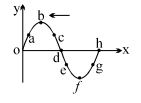
The figure represents the instantaneous picture of a transverse harmonic wave traveling along the negative $x$-axis. Choose the correct alternative $(s)$ related to the movement of the nine points shown in the figure. The points moving with maximum velocity is/are
Medium


Download our appand get started for free
Experience the future of education. Simply download our apps or reach out to us for more information. Let's shape the future of learning together!No signup needed.*
Similar Questions
- 1The second overtone of an open organ pipe has the same frequency as the first overtone of a closed pipe $L$ metre long. The length of the open pipe will beView Solution
- 2An observer is moving away from source of sound of frequency $100 Hz$. His speed is $33 \,m/s$. If speed of sound is $330 \,m/s$, then the observed frequency is .... $Hz$View Solution
- 3Ten tuning forks are arranged in increasing order of frequency in such a way that any two consecutive tuning forks produce $4$ beats per second. The highest frequency is twice that of the lowest. Possible highest and lowest frequencies (in $Hz$ ) are ................View Solution
- 4A stretched string resonates with tuning fork frequency $512\; Hz$ when length of the string is $0.5\; m$. The length of the string required to vibrate resonantly with a tuning fork of frequency $256 \;Hz$ would be .......... $m$View Solution
- 5A vibrating string of certain length $l$ under a tension $T$ reasonates with a mode corresponding to the first overtone (third harmonic) of an air column of length $75$ $cm$ inside a tube closed at one end. The string also generates $4$ beats per second when excited along with a tuning fork of frequency $n$. Now when the tension of the string is slightly increased the number of beats reduces to $2$ per second. Assuming the velocity of sound in air to be $340$ $m/s$, the frequency $n$ of the tuning fork in $Hz $ isView Solution
- 6If the length of a stretched string is shortened by $40\%$ and the tension is increased by $44\%$, then the ratio of the final and initial fundamental frequencies isView Solution
- 7A person standing on an open ground hears the sound of a jet aeroplane, coming from north at an angle $60^o$ with ground level. But he finds the aeroplane right vertically above his position. If $\upsilon $ is the speed of sound, speed of the plane isView Solution
- 8View SolutionIn a standing wave, all particles of the medium cross the mean position with
- 9Beats are produced with the help of two sound waves of amplitudes $3$ and $5$ units. The ratio of maximum to minimum intensity in the beats isView Solution
- 10If $T$ is the reverberation time of an auditorium of volume $V$ thenView Solution