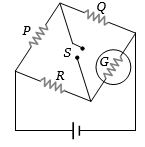
The figure shows a circuit diagram of a ‘Wheatstone Bridge’ to measure the resistance $G$ of the galvanometer. The relation $\frac{P}{Q} = \frac{R}{G}$ will be satisfied only when
Easy


Download our appand get started for free
Experience the future of education. Simply download our apps or reach out to us for more information. Let's shape the future of learning together!No signup needed.*
Similar Questions
- 1There is a current of $40$ ampere in a wire of ${10^{ - 6}}\,{m^2}$ area of cross-section. If the number of free electron per ${m^3}$ is ${10^{29}}$, then the drift velocity will beView Solution
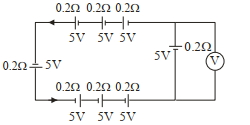
- 2The reading in the ideal voltmeter $(V)$ shown in the given circuit diagram is :View Solution
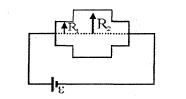
- 3A cylindrical resistance is connected across battery $\varepsilon $ . Cylinder has uniform free electron density, mid part of cylinder has larger radius as shown in figure. Then $V_d$ (drift velocity) $V/S$ (distance across the length of the resistance)View Solution
- 4In a potentiometer experiment, the galvanometer shows no deflection when a cell is connected across $60\, cm$ of the potentiometer wire. If the cell is shunted by a resistance of $6\,\Omega $, the balance is obtained across $50\, cm$ of the wire. The internal resistance of the cell is .............. $\Omega $View Solution
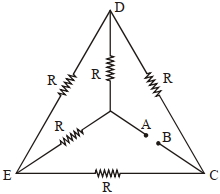
- 5Five equal resistances are connected in a network as shown in figure. The net resistance between the points $A$ and $B$ isView Solution
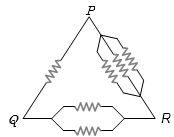
- 6Six equal resistances are connected between points $P$, $Q$ and $R$ as shown in the figure. Then the net resistance will be maximum betweenView Solution
- 7View SolutionBy increasing the temperature, the specific resistance of a conductor and a semiconductor
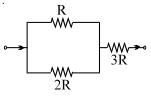
- 8The ratio of powers dissipatted respectively in $R$ and $3R$, as shown is:View Solution
- 9View SolutionConsider four circuits shown in the figure below. In which circuit power dissipated is greatest (Neglect the internal resistance of the power supply)
- 10An electric toaster has resistance of $60\ \Omega$ at room temperature $\left(27^{\circ} \mathrm{C}\right)$. The toaster is connected to a $220 \mathrm{~V}$ supply. If the current flowing through it reaches $2.75 \mathrm{~A}$, the temperature attained by toaster is around : (if $\alpha=2 \times 10^{-4} /{ }^{\circ} \mathrm{C}$ )View Solution