The figure shows a family of parallel equipotential surfaces and four paths along which an electron is made to move from one surface to another as shown in the figur
$(I)$ What is the direction of the electric field ?
$(II)$ Rank the paths according to magnitude of work done, greatest first
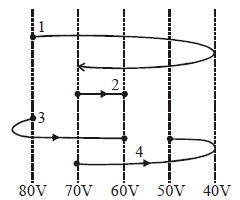
$(I)$ What is the direction of the electric field ?
$(II)$ Rank the paths according to magnitude of work done, greatest first
Medium
Download our app for free and get started
Along the direction of electric field, electric potential decreases, hence it should be from left to right.
Change in potential of path $3$ and $4$ is greater hence
$3=4>2=1$

Download our appand get started for free
Experience the future of education. Simply download our apps or reach out to us for more information. Let's shape the future of learning together!No signup needed.*
Similar Questions
- 1Match the pairsView Solution
Capacitor Capacitance $(A)$ Cylindrical capacitor $(i)$ ${4\pi { \in _0}R}$ $(B)$ Spherical capacitor $(ii)$ $\frac{{KA{ \in _0}}}{d}$ $(C)$ Parallel plate capacitor having dielectric between its plates $(iii)$ $\frac{{2\pi{ \in _0}\ell }}{{ln\left( {{r_2}/{r_1}} \right)}}$ $(D)$ Isolated spherical conductor $(iv)$ $\frac{{4\pi { \in _0}{r_1}{r_2}}}{{{r_2} - {r_1}}}$ - 2In free space, a particle $A$ of charge $1\,\mu C$ is held fixed at a point $P.$ Another particle $B$ of the same charge and mass $4\,\mu g$ is kept at a distance of $1\,mm$ from $P$. If $B$ is released, then its velocity at a distance of $9\,mm$ from $P$ is [ Take $\frac{1}{{4\pi {\varepsilon _0}}} = 9 \times {10^9}\,N{m^2}{C^{ - 2}}$ ]View Solution
- 3The electric potential $V$ at any point $O$ ($x$, $y$, $z$ all in metres) in space is given by $V = 4{x^2}\,volt$. The electric field at the point $(1m,\,0,\,2m)$ in $volt/metre$ isView Solution
- 4View SolutionA parallel plate capacitor is charged. Then battery is removed now If the plates are pulled apart
- 5The diagram shows three infinitely long uniform line charges placed on the $X, Y $ and $Z$ axis. The work done in moving a unit positive charge from $(1, 1, 1) $ to $(0, 1, 1) $ is equal toView Solution
- 6Two identical capacitors, have the same capacitance $C$. One of them is charged to potential ${V_1}$ and the other to ${V_2}$. The negative ends of the capacitors are connected together. When the positive ends are also connected, the decrease in energy of the combined system isView Solution
- 7A capacitor has air as dielectric medium and two conducting plates of area $12 \mathrm{~cm}^2$ and they are $0.6 \mathrm{~cm}$ apart. When a slab of dielectric having area $12 \mathrm{~cm}^2$ and $0.6 \mathrm{~cm}$ thickness is inserted between the plates, one of the conducting plates has to be moved by $0.2 \mathrm{~cm}$ to keep the capacitance same as in previous case. The dielectric constant of the slab is : (Given $\left.\in_0=8.834 \times 10^{-12} \mathrm{~F} / \mathrm{m}\right)$View Solution
- 8View SolutionA parallel plate capacitor is charged to a certain potential and the charging battery is then disconnected. Now, if the plates of the capacitor are moved apart then:
- 9Two charge $ + \,q$ and $ - \,q$ are situated at a certain distance. At the point exactly midway between themView Solution
- 10$IAn$ empty thick conducting shell of inner radius $a$ and outer radius $b$ is shown in figure.If it is observed that the inner face of the shell carries a uniform charge density $-\sigma$ and the surface carries a uniform charge density $ '\sigma '$View Solution
Choose the correct statement related to the potential of the shell in absence of $q_B$