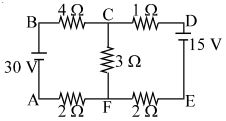
The figure shows a network of five resistances and two batteries The total electrical power consumed by the circuit is ............... $W$
Diffcult


Download our appand get started for free
Experience the future of education. Simply download our apps or reach out to us for more information. Let's shape the future of learning together!No signup needed.*
Similar Questions
- 1When two resistance $R_1$ and $R_2$ connected in series and introduced into the left gap of a meter bridge and a resistance of $10 \Omega$ is introduced into the right gap, a null point is found at $60 cm$ from left side. When $R_1$ and $R_2$ are connected in parallel and introduced into the left gap, a resistance of $3 \Omega$ is introduced into the right-gap to get null point at 40 cm from left end. The product of $R_1 R_2$ is $.............\Omega$View Solution
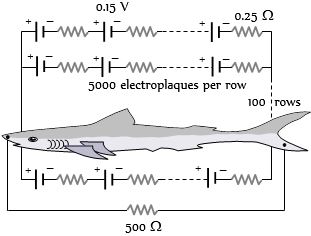
- 2Eels are able to generate current with biological cells called electroplaques. The electroplaques in an eel are arranged in $100$ rows, each row stretching horizontally along the body of the fish containing $5000$ electroplaques. The arrangement is suggestively shown below. Each electroplaques has an emf of $0.15\, V$ and internal resistance of $0.25 \,\Omega$ The water surrounding the eel completes a circuit between the head and its tail. If the water surrounding it has a resistance of $500 \,\Omega$, the current an eel can produce in water is about .............. $A$View Solution
- 3The maximum power drawn out of the cell from a source is given by (where $r$ is internal resistance)View Solution
- 4In a conductor $4$ coulombs of charge flows for $2$ seconds. The value of electric current will beView Solution
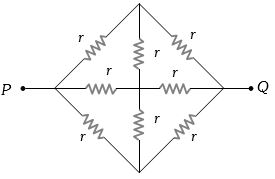
- 5The equivalent resistance between the points $P$ and $Q$ in the network given here is equal to ................ $\Omega$ (given $r = \frac{3}{2}\Omega $)View Solution
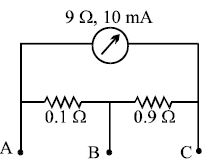
- 6A milliammeter of range $10\, mA$ and resistance $9\, \Omega$ is joined in a circuit as shown. The meter gives full-scale deflection for current $I$ when $A$ and $B$ are used as its terminals, i.e., current enters at $A$ and leaves at $B$ ($C$ is left isolated). The value of $I$ isView Solution
- 7A uniform wire of resistance $9$ $\Omega$ is cut into $3$ equal parts. They are connected in the form of equilateral triangle $ABC$. A cell of $e.m.f.$ $2\,V$ and negligible internal resistance is connected across $B$ and $C$. Potential difference across $AB$ is ............... $V$View Solution
- 8View SolutionIdentify the set in which all the three materials are good conductors of electricity
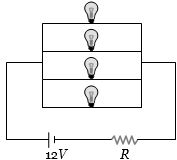
- 9Four identical electrical lamps are labelled $1.5\,V$, $0.5\,A$ which describes the condition necessary for them to operate at normal brightness. A $12\,V$ battery of negligible internal resistance is connected to lamps as shown, thenView Solution
- 10Three unequal resistors in parallel are equivalent to a resistance $1\, ohm$. If two of them are in the ratio $1 : 2$ and if no resistance value is fractional, the largest of the three resistances in $ohms$ isView Solution