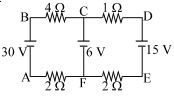
The figure shows a network of four resistances and three batteries The current through the branch $CF$ is ............... $A$
Diffcult
Download our app for free and get started

Download our appand get started for free
Experience the future of education. Simply download our apps or reach out to us for more information. Let's shape the future of learning together!No signup needed.*
Similar Questions
- 1There is a current of $40$ ampere in a wire of ${10^{ - 6}}\,{m^2}$ area of cross-section. If the number of free electron per ${m^3}$ is ${10^{29}}$, then the drift velocity will beView Solution
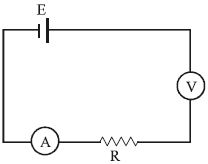
- 2Assertion : All electric devices shown in the circuit are ideal. The reading of each of ammeter $(a)$ and voltmeter $(V)$ is zero.View Solution
Reason : An ideal voltmeter draws almost no current due to very large resistance, and hence $(V)$ and $(a)$ will read zero.
- 3View SolutionWhen electric bulbs of same power, but different marked voltage are connected in series across the power line, their brightness will be :
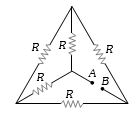
- 4$A$ battery is of $\mathrm{emf}$ $E$ is being charged from a charger such that positive terminal of the battery is connected to terminal $A$ of charger and negative terminal of the battery is connected to terminal $B$ of charger. The internal resistance of the battery is $r$.View Solution
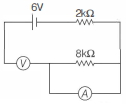
- 5In the circuit shown below, a student performing Ohm's law experiment accidently puts the voltmeter and the ammeter as shown in the circuit below. The reading in the voltmeter will be close to .......... $V$View Solution
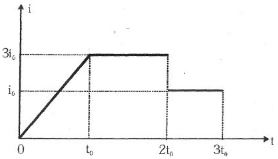
- 6A time varying current $i$ is passed through a resistance $R$ as shown in figure. The total heat generated in the resistance isView Solution
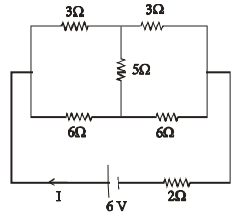
- 7A battery of $6\,V$ is connected to the circuit as shown below. The current I drawn from the battery is:View Solution
- 8View SolutionTwo resistors having equal resistances are joined in series and a current is passed through the combination. Neglect any variation in resistance as the temperature changes. In a given time interval
- 9The drift velocity of electrons for a conductor connected in an electrical circuit is $V _{ d }$. The conductor in now replaced by another conductor with same material and same length but double the area of cross section. The applied voltage remains same. The new drift velocity of electrons will beView Solution
- 10Each of the resistance in the network shown in fig. is equal to $R$. The resistance between the terminals $A$ and $B$ isView Solution