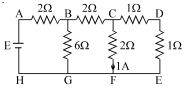
The figure shows a network of resistors and $a$ battery. If $1\,A$ current flowsthrough the branch $CF$, then answer the following questions The current through
Diffcult


Download our appand get started for free
Experience the future of education. Simply download our apps or reach out to us for more information. Let's shape the future of learning together!No signup needed.*
Similar Questions
- 1A heater of $220\, V$ heats a volume of water in $5\,\min$ time. A heater of $110\, V$ heats the same volume of water in ............... $min$View Solution
- 2View SolutionOhm's law fails in
- 3A resistor ${R_1}$ dissipates the power $P$ when connected to a certain generator. If the resistor ${R_2}$ is put in series with ${R_1}$, the power dissipated by ${R_1}$View Solution
- 4The current in the arm $CD$ of the circuit will beView Solution
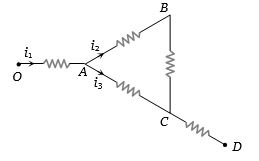
- 5Which of the following wiring diagrams could be used to experimentally determine $R$ using ohm's law? Assume an ideal voltmeter and an ideal ammeter.View Solution
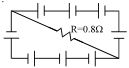
- 6$\mathrm{A}$ circuit is comprised of eight identical batteries and a resistor $R = 0.8\,\Omega$ . Each battery has an $\mathrm{emf}$ of $1.0\, V$ and internal resistance of $0.2\,\Omega$ . The voltage difference across any of the battery is ............. $V$View Solution
- 7In a Wheatstone’s bridge all the four arms have equal resistance $R$. If the resistance of the galvanometer arm is also $R$, the equivalent resistance of the combination as seen by the battery isView Solution
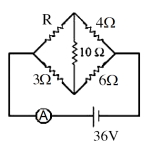
- 8Current measured by the ammeter $(A)$ in the reported circuit when no current flows through $10\,\Omega$ resistance. will be________$A$View Solution
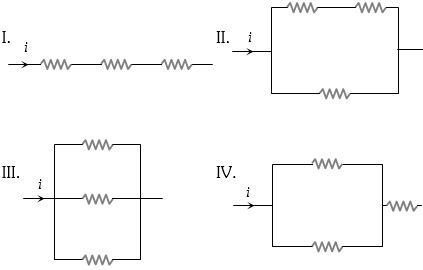
- 9View SolutionThe three resistance of equal value are arranged in the different combinations shown below. Arrange them in increasing order of power dissipation.
- 10$AB$ is a wire of uniform resistance. The galvanometer $G$ shows no current when the length $AC = 20\,cm$ and $CB = 80\, cm$. The resistance $R$ is equal to .............. $\Omega $View Solution