A heater of $220\, V$ heats a volume of water in $5\,\min$ time. A heater of $110\, V$ heats the same volume of water in ............... $min$
Easy


Download our appand get started for free
Experience the future of education. Simply download our apps or reach out to us for more information. Let's shape the future of learning together!No signup needed.*
Similar Questions
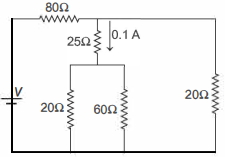
- 1A current of $0.1 \,A$ flows through a $25 \,\Omega$ resistor represented by the circuit diagram. The current in $80 \,\Omega$ resistor is ........... $A$View Solution
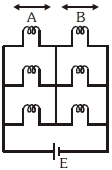
- 2Six similar bulbs are connected as shown in the figure with a $DC$ source of $emf\; E$, and zero internal resistance. The ratio of power consumption by the bulbs when $(i)$ all are glowing and $(ii)$ in the situation when two from section $A$ and one from section $B$ are glowing, will beView Solution
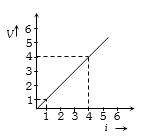
- 3Variation of current and voltage in a conductor has been shown in the diagram below. The resistance of the conductor is. ........... $ohm$View Solution
- 4The resistance of a heater coil is $110\, ohm$. A resistance $R$ is connected in parallel with it and the combination is joined in series with a resistance of $11\, ohm$ to a $220\, volt$ main line. The heater operates with a power of $110\, watt$. The value of $R$ in $ohm$ isView Solution
- 5A potential difference of $V$ is applied at the ends of a copper wire of length $l$ and diameter $d$. On doubling only $d$, drift velocityView Solution
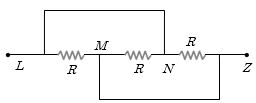
- 6Three equal resistances each of value $R$ are joined as shown in the figure. The equivalent resistance between $M$ and $N$ isView Solution
- 7Four wires of equal length and of resistances $10$ $ ohms$ each are connected in the form of a square. The equivalent resistance between two opposite corners of the square is ............. $ohm$View Solution
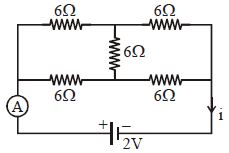
- 8View SolutionReading of ammeter in ampere for the following circuit is
- 9A solenoid is at potential difference $60\, V$ and current flows through it is $15$ ampere, then the resistance of coil will be ............ $\Omega$View Solution
- 10$A$ wire of cross-section area $A$, length $L_1$, resistivity $\rho_1$ and temperature coefficient of resistivity $\alpha_1$ is connected to a second wire of length $L_2$, resistivity $\rho_2$ , temperature coefficient of resistivity $\alpha_1$ and the same area $A$, so that wire carries same current. Total resistance $R$ is independent of temperature for small temperature change if (Thermal expansion effect is negligible)View Solution