MCQ
The figure shows a nonconducting ring which has positive and negative charge non uniformly distributed on it such that the total charge is zero. Which of the following statements is true?
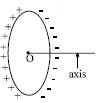
  • The potential at all the points on the axis will be zero.
  • B
    The electric field at all the points on the axis will be zero.
  • C
    The direction of electric field at all points on the axis will be along the axis.
  • D
    If the ring is placed inside a uniform external electric field then net torque and force acting on the ring would be zero.
Answer

Correct option: A.
The potential at all the points on the axis will be zero.
a
By symmetry potential due to negative part $=$(potential due to particle part). (Also every small charge is equidistant from axis)

$\therefore$ Potential at all potential axis is zero

Direction of field is perpendicular to axis and towards negative side

There will be a torque when placed in uniform field

Need a full question paper?

Generate a complete, print-ready paper with questions like this in minutes — across 16+ boards, with answer keys.

Start Generating Free

Similar questions

The difference in the variation of resistance with temperature in a metal and a semiconductor arises essentially due to the difference in the
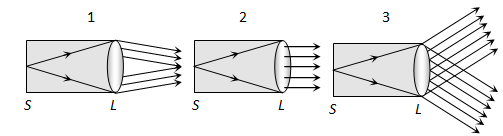
The slit of a collimator is illuminated by a source as shown in the adjoining figures. The distance between the slit S and the collimating lens L is equal to the focal length of the lens. The correct direction of the emergent beam will be as shown in figure
If a dipole of dipole moment $\vec p$ is placed in a uniform electric field $\vec E$, then torque acting on it is given by
A wire is broken in four equal parts. A packet is formed by keeping the four wires together. The resistance of the packet in comparison to the resistance of the wire will be
Radio waves and visible light in vacuum have
A short-circuited coil is placed in a time-varying magnetic field. Electrical power is dissipated due to the current induced in the coil. If the number of turns were to be quadrupled and the wire radius halved, the electrical power dissipated would be
A student can distinctly see the object upto a distance $15 cm.$ He wants to see the black board at a distance of $3 m.$ Focal length and power of lens used respectively will be
The torque acting on a dipole of moment $\vec P$ in an electric field $\vec E$ is
Assertion : Interference pattern is made by using blue light instead of red light, the fringes becomes narrower.
Reason : In Young’s double slit experiment, fringe width is given by relation $B = \frac{\lambda \mathrm{D}}{\mathrm{d}}$.
A point source of light moves in a straight line parallel to a plane table. Consider a small portion of the table directly below the line of movement of the source. The illuminance at this portion varies with its distance $r$ from the source as