MCQ
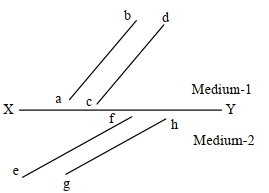
The figure shows a surface $XY$ separating two transparent media, medium -$1$ and medium -$2$. The lines $a b$ and cd represent wavefronts of a light wave travelling in medium-$1$ and incident on $XY$. The lines ef and gh represent wavefronts of the light wave in medium-$2$ after refraction.

$Image$

$1.$  Light travels as a

$(A)$ parallel beam in each medium

$(B)$ convergent beam in each medium

$(C)$ divergent beam in each medium

$(D)$ divergent beam in one medium and convergent beam in the other medium.

$2.$  The phases of the light wave at $\mathrm{c}, \mathrm{d}, \mathrm{e}$ and $\mathrm{f}$ are $\phi_{\mathrm{c}}, \phi_{\mathrm{d}}, \phi_{\mathrm{e}}$ and $\phi_{\mathrm{f}}$ respectively. It is given that $\phi_{\mathrm{c}} \neq \phi_{\mathrm{f}}$

$(A)$ $\phi_{\mathrm{c}}$ cannot be equal to $\phi_{\mathrm{d}}$

$(B)$ $\phi_{\mathrm{a}}$ can be equal to $\phi_{\mathrm{e}}$

$(C)$ $\left(\phi_{\mathrm{d}}-\phi_t\right)$ is equal to $\left(\phi_{\mathrm{c}}-\phi_{\mathrm{e}}\right)$

$(D)$ $\left(\phi_{\mathrm{d}}-\phi_c\right)$ is not equal to $\left(\phi_{\mathrm{f}}-\phi_e\right)$

$3.$  Speed of the light is

$(A)$ the same in medium-$1$ and medium-$2$

$(B)$ larger in medium-$1$ than in medium-$2$

$(C)$ larger in medium-$2$ than in medium-$1$

$(D)$ different at $\mathrm{b}$ and $\mathrm{d}$

Give the answer question $1, 2$ and $3.$
  • $A,C,B$
  • B
    $B,D,A$
  • C
    $C,D,A$
  • D
    $D,A,B$

Answer

Correct option: A.
$A,C,B$
a

Need a full question paper?

Generate a complete, print-ready paper with questions like this in minutes — across 16+ boards, with answer keys.

Start Generating Free

Similar questions

In a YDSE bi-chromatic light of wavelengths 400 nm and 560 nm are used. The distance between the slits is 0.1 mm and the distance between the plane of the slits and the screen is 1m. The minimum distance between two successive regions of complete darkness is
A thin prism of refracting angle $2^o$ deviates an incident ray through an angle of $1^o$.   Find the value of refractive index of the material of the prism
Letters $A , B , C$ and $D$ are written on a cardboard as shown in the figure below. The cardboard is kept at a suitable distance behind a transparent empty glass of cylindrical shape. If the glass is now filled with water, one sees an inverted image of the pattern on the cardboard when looking through the glass. Ignoring magnification effects, the image would appear as
Light passes successively through two polarimeters tubes each of length $0.29 m$ . The first tube contains dextro rotatory solution of concentration $60 \mathrm{kgm}^{-3}$ and specific rotation $0.01 \mathrm{rad} \mathrm{~m}^{2222222222222222222222} \mathrm{~kg}^{-1}$. The second tube contains laevo rotatory solution of concentration $30 \mathrm{~kg} / \mathrm{m}^3$ and specific rotation $0.02 \mathrm{radm}^2 \mathrm{~kg}^{-1}$. The net rotation produced is
Two identical batteries, each of e.m.f. 2 volt and internal resistance 1.0 ohm are available to produce heat in an external resistance R = 0.5 ohm by passing a current through it. The maximum Joulean power that can be developed across R using these batteries is
Assertion : Ohm’s law cannot be applied to $a.c$ circuit.

Reason : Resistance offered by capacitor for a.c source depends upon the frequency of the source.

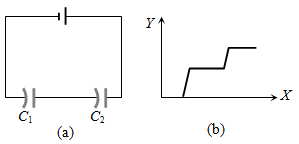
Figure $(a)$ shows two capacitors connected in series and joined to a battery. The graph in figure $(b)$ shows the variation in potential as one moves from left to right on the branch containing the capacitors, if


The unit of intensity of electric field is
An unpolarised light beam strikes a glass surface at Brewster's angle. Then
A parallel plate capacitor has circular plates of $0.08\,m$ radius and $1.0 \times {10^{ - 3}}\,m$ separation. If a $P.D.$ of $100\;volt$ is applied, the charge will be