MCQ
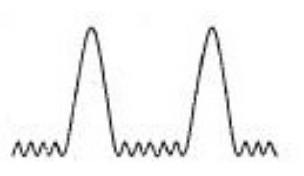
The figure shows diffraction pattern of two nearby points. The two points are:
- ANot resolved
- BJust resolved
- CClearly resolved
- DNone
Explanation:
Since there are a number of crests in between the peaks of the two points, they clearly do not immerse into each other at all, thus they are clearly resolved.
Generate a complete, print-ready paper with questions like this in minutes — across 16+ boards, with answer keys.
A capacitor of 10mF charged up to 250 volts is connected in parallel with another capacitor of 5mF charged up to 100 volts. The common potential is
|
(a) 500 V |
(b) 400 V |
(c) 300 V |
(d) 200 V |
When phosphorus and antimony are mixed in zermaniun, then
|
(a) P-type semiconductor is formed |
(b) N-type semiconductor is formed |
|
(c) Both (a) and (b) |
(d) None of these |
A convex lens of focal length f produces an image  times than that of the size of the object. The distance of the object from the lens is
|
(a) nf |
(b) |
(c) (n + 1)f |
(d) (n – 1)f |
A flake of glass (refractive index 1.5) is placed over one of the openings of a double slit apparatus. The interference pattern displaces itself through seven successive maxima towards the side where the flake is placed. if wavelength of the diffracted light is λ = 600nm, then the thickness of the flake is
|
(a) 2100 nm |
(b) 4200 nm |
(c) 8400 nm |
(d) None of these |
The cold junction of a thermocouple is maintained at 10℃. No thermo e.m.f. is developed when the hot junction is maintained at 530 ℃ . The neutral temperature is
|
(a) 260℃ |
(b) 270℃ |
(c) 265℃ |
(d) 520℃ |
Plane polarised light is passed through a polaroid. On viewing through the polaroid we find that when the polariod is given one complete rotation about the direction of the light, one of the following is observed
|
(a) The intensity of light gradually decreases to zero and remains at zero |
|
(b) The intensity of light gradually increases to a maximum and remains at maximum |
|
(c) There is no change in intensity |
|
(d) The intensity of light is twice maximum and twice zero |
