Question
✓
Answer
1. (c) $1+2 / n$
Explanation: $1+2 / n$
2. (c) kT
Explanation: kT
3. (c) the average distance covered by a molecule between two successive collisions
Explanation: the average distance covered by a molecule between two successive collisions
4. (b) in random motion
Explanation: in random motion
OR
(b) 4.148 joule
Explanation: 4.148 joule
Explanation: $1+2 / n$
2. (c) kT
Explanation: kT
3. (c) the average distance covered by a molecule between two successive collisions
Explanation: the average distance covered by a molecule between two successive collisions
4. (b) in random motion
Explanation: in random motion
OR
(b) 4.148 joule
Explanation: 4.148 joule
Need a full question paper?
Generate a complete, print-ready paper with questions like this in minutes — across 16+ boards, with answer keys.
Explore more
Similar questions
A narrow pencil of parallel light is incident normally on a solid transparent sphere of radius r. What should be the refractive index if the pencil is to he focused.
- At the surface of the sphere.
- At the centre of the sphere.
The friction coefficient between an athelete's shoes and the ground is 0.90. Suppose a superman wears these shoes and races for 50m. There is no upper limit on his capacity of running at high speeds.
- Find the minimum time that he will have to take in completing the 50m starting from rest.
- Suppose he takes exactly this minimum time to complete the 50m, what minimum time will he take to stop?
The magnetometer of the previous problem is used with the same magnet in $\tan-\text{B}$ position. Where should the magnet be placed to produce a 37° deflection of the needle?
→The plate resistance of a triode is $8\text{k}\Omega$ and the transconductance is 2.5 milliohm. (a) If the plate voltage is increased by 48V and the grid voltage is kept constant, what will be the increase in the plate current? (b) With plate voltage kept constant at this increased value, by how much should the grid voltage be decreased in order to bring the plate current back to its initial value?
→Would you prefer a material with a high melting point or a low melting point to be used as a cathode in a diode?
Read the passage given below and answer the following questions from 1 to 5. First Law of Thermodynamics The first law of thermodynamics is the general law of conservation of energy applied to any system in which energy transfer from or to the surroundings (through heat and work) is taken into account. It states that the energy supplied to the system goes in partly to increase the internal energy of the system and the rest in work on the environment. Mathematically, $\triangle\text{Q}=\triangle\text{U}+\triangle\text{W}$ where $\triangle\text{Q}$ is the heat supplied to the system, $\triangle\text{W}$ is the work done by the system and $\triangle\text{U}$ is the change in internal energy of the system. $\triangle\text{Q}$ and $\triangle\text{W}$ depend on the path taken to go from initial to final states, but the combination $\triangle\text{Q}-\triangle\text{W}$ is path independent.
→- The first law of thermodynamics is concerned with conservation of:
- Number of molecules
- Number of moles
- Energy
- Temperature
- Which of the following is not a path function?
- $\triangle\text{Q}$
- $\triangle\text{Q}+\triangle\text{W}$
- $\triangle\text{W}$
- $\triangle\text{Q}-\triangle\text{W}$
- An electric heater supplies heat to a system at a rate of 120W. If system performs work at a rate of $80 J s^{-1}$, the rate of increase in internal energy is:
- $30 J s^{-1}$
- $40 J s^{-1}$
- $50 J s^{-1}$
- $60 J s^{-1}$
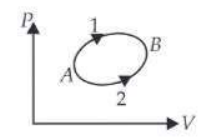
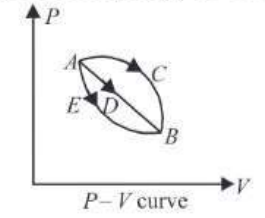
- Asystem goes from A to B by two different paths in the P - V diagram as shown in figure. Heat given to the system in path 1 is 1100 J, the work done by the system along path 1 is more than path 2 by 150 J. The heat exchanged by the system in path 2 is:
- 800 J
- 750 J
- 1050 J
- 950 J
- A certain mass of gas is carried from A to B, along three paths via ACB, ADB and AEB. Which one of the following is correct?
- Work done via path ACB is minimum.
- Work done via path ADB is maximum.
- Work done via path ACB is maximum.
- Work done via path AEB is maximum.
Read the passage given below and answer the following questions from 1 to 5. The first law refers to the simple case when the net external force on a body is zero. The second law of motion refers to the general situation when there is net external force acting on the body. It relates the net external force to the acceleration of the body. These qualitative observations lead to the second law of motion expressed by Newton as follow: The rate of change of momentum of a body is directly proportional to the applied force and takes place in the direction in which the force acts. Thus, if under the action of a force F for time interval $\triangle\text{t},$ the velocity of a body of mass m changes from v to $\text{v}+\triangle\text{v},$ i.e. its initial momentum p = m v changes by $\triangle\text{p}=\text{m}\triangle\text{v}.$ According to the Second Law $\text{F}\alpha\frac{\triangle\text{p}}{\triangle\text{t}}$ or $\text{F}=\text{k}\frac{\triangle\text{P}}{\triangle\text{t}}$ Where k is a constant of proportionality. Mathematically, F = ma, the unit of force is $kg-m/s^2$ or Newton, which has the symbol N. Let us note at this stage some important points about the second law:
→- In the second law, F = 0 implies a = 0. The second law is obviously consistent with the first law.
- The second law of motion is a vector law.
- The second law of motion given by is applicable to a single point particle as well as to the rigid body but internal forces is not considered in F.
- The second law of motion is a local relation which means that force F at a point in space (location of the particle) at a certain instant of time is related to a at that point at that instant.
- SI unit of force is:
- Newton
- Pascal
- m/s
- None of the above
- According to second law of motion The rate of change of momentum of a body is directly proportional to
- Velocity of body
- Applied force
- Only mass of body
- None of the above.
- The second law of motion is:
- Vector law
- Scalar law
- State second law of motion.
- Write a note on $2^{nd}$ law of motion. Enlist some deductions from $2^{nd} $ law.
A ladder is resting with one end on a vertical wall and the other end on a horizontal floor. Is it more likely to slip when a man stands near the bottom or near the top?