MCQ
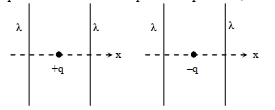
The figures below depict two situations in which two infinitely long static line charges of constant positive line charge density $\lambda$ are kept parallel to each other. In their resulting electric field, point charges $q$ and $- q$ are kept in equilibrium between them. The point charges are confined to move in the $x$ direction only. If they are given a small displacement about their equilibrium positions, then the correct statement$(s)$ is(are)
- ABoth charges execute simple harmonic motion.
- BBoth charges will continue moving in the direction of their displacement.
- ✓Charge $+ q$ executes simple harmonic motion while charge $- q$ continues moving in the direction of its displacement.
- DCharge $- q$ executes simple harmonic motion while charge $+ q$ continues moving in the direction of its displacement.