The filament of a light bulb has surface area $64 mm ^2$. The filament can be considered as a black body at temperature $2500 K$ emitting radiation like a point source when viewed from far. At night the light bulb is observed from a distance of $100 m$. Assume the pupil of the eyes of the observer to be circular with radius $3 mm$. Then
(Take Stefan-Boltzmann constant $=5.67 \times 10^{-8} Wm ^{-2} K ^{-4}$, Wien's displacement constant $=2.90 \times 10^{-3} m - K$, Planck's constant $=6.63 \times 10^{-34} Js$, speed of light in vacuum $=3.00 \times 10^8 ms ^{-1}$ )-
$(A)$ power radiated by the filament is in the range $642 W$ to $645 W$
$(B)$ radiated power entering into one eye of the observer is in the range $3.15 \times 10^{-8} W$ to $3.25 \times 10^{-8} W$
$(C)$ the wavelength corresponding to the maximum intensity of light is $1160 nm$
$(D)$ taking the average wavelength of emitted radiation to be $1740 nm$, the total number of photons entering per second into one eye of the observer is in the range $2.75 \times 10^{11}$ to $2.85 \times 10^{11}$
IIT 2020, Medium
Download our app for free and get started
$A=64 mm ^2, T =2500 K ( A =$ surface area of filament, $T =$ temperature of filament, $d$ is distance of bulb from observer, $R_c=$ radius of pupil of eye)
Point source $d =100 m$
$R_c=3 mm$
$(A)$ $P =\sigma AeT ^4$
$=5.67 \times 10^{-3} \times 64 \times 10^{-6} \times 1 \times(2500)^4(e=1 \text { black body })$
$=141.75 w$
Option $(A)$ is wrong
$(B)$ Power reaching to the eye
$=\frac{ P }{4 \pi d ^2} \times\left(\pi R _e^2\right)$
$=\frac{141.75}{4 \pi \times(100)^2} \times \pi \times\left(3 \times 10^{-1}\right)^2$
$=3.189375 \times 10^{-8} W$
Option $(B)$ is correct
$(C)$
$\lambda_{ m } T = b$
$\lambda_{ m } \times 2500=2.9 \times 10^{-3}$
$\Rightarrow \lambda_{ m } =1.16 \times 10^{-6}$
$ =1160 mm$
Option $(C)$ is correct
$(D)$ Power received by one eye of observer $=\left(\frac{ hc }{\lambda}\right) \times \dot{ N }$
$\dot{ N }=\text { Number of photons entering into eye per second }$
$\Rightarrow 3.189375 \times 10^{-8}$
$=\frac{6.63 \times 10^{-34} \times 3 \times 10^x}{1740 \times 10^{-9}} \times \dot{N}$
$\Rightarrow \dot{N}=2.79 \times 10^{11}$

Download our appand get started for free
Experience the future of education. Simply download our apps or reach out to us for more information. Let's shape the future of learning together!No signup needed.*
Similar Questions
- 1Three objects colored black, gray and white can withstand hostile conditions upto $2800\,^oC$. These objects are thrown into a furnace where each of them attains a temperature of $2000\,^oC$. Which object will glow brightest?View Solution
- 2A body cools from ${60^o}C$ to ${50^o}C$ in $10$ minutes when kept in air at ${30^o}C$. In the next $10$ minutes its temperature will beView Solution
- 3In the Ingen Hauz’s experiment the wax melts up to lengths $10$ and $25 cm$ on two identical rods of different materials. The ratio of thermal conductivities of the two materials isView Solution
- 4Certain quantity of water cools from $70^o C$ to $60^o C$ in the first $5$ minutes and to $54^o C$ in the next $5$ minutes. The temperature of the surroundings is ..... $^oC$View Solution
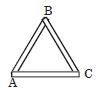
- 5Three rods $AB, BC$ and $AC$ having thermal resistances of $10\, units, \,10 \,units$ and $20 \,units,$ respectively, are connected as shown in the figure. Ends $A$ and $C$ are maintained at constant temperatures of $100^o C$ and $0^o C,$ respectively. The rate at which the heat is crossing junction $B$ is ........ $ \mathrm{units}$View Solution
- 6View SolutionA hot and a cold body are kept in vacuum separated from each other. Which of the following cause decrease in temperature of the hot body
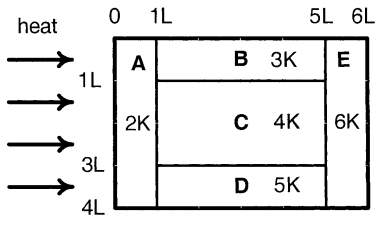
- 7A composite block is made of slabs $A, B, C, D$ and $E$ of different thermal conductivities (given in terms of a constant $K$ ) and sizes (given in terms of length, $L$ ) as shown in the figure. All slabs are of same width. Heat $'Q'$ flows only from left to right through the blocks. Then in steady state $Image$View Solution
$(A)$ heat flow through $A$ and $E$ slabs are same.
$(B)$ heat flow through slab $E$ is maximum.
$(C)$ temperature difference across slab $E$ is smallest.
$(D)$ heat flow through $C =$ heat flow through $B +$ heat flow through $D$.
- 8View SolutionAt a common temperature, a block of wood and a block of metal feel equally cold or hot. The temperatures of block of wood and block of metal are
- 9A body cools from a temperature $3T$ to $2T$ in $10$ minutes. The room temperature is $T.$ Assume that Newton's law of cooling is applicable. The temperature of the body at the end of next $10$ minutes will beView Solution
- 10View SolutionAccording to Wein's law