MCQ
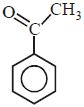
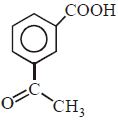
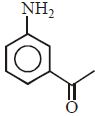
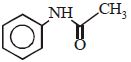
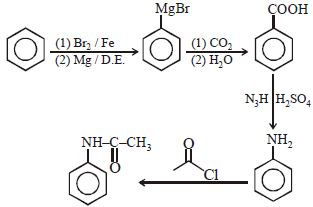
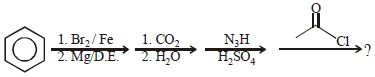
The final product of the given sequence is :
  • A

  • B

  • C


Answer

Correct option: D.

d

Need a full question paper?

Generate a complete, print-ready paper with questions like this in minutes — across 16+ boards, with answer keys.

Start Generating Free

Similar questions

A $0.2\,molal$ aqueous solution of a weak acid $(HX)$ is $20\% $  ionised. The freezing point of this solution is .............. $^o  \mathrm{C}$   (Given ${K_f} = {1.86^o}\,C/m$ for water)
Which has trigonal bipyramidal shape ?
The electrode reaction that takes place at anode of $CH_4-O_2$ fuel cell is ?
The vapour pressure of two pure liquids $(A)$ and $(B)$ are $100$ and $80\,torr$ respectively. The total pressure of solution obtained by mixing $2\,mole$ of $(A)$ and $3\,mole$ of $(B)$ would be ........ $torr$.
$Cu ( s )+ Sn ^{2+}(0.001 M ) \rightarrow Cu ^{2+}(0.01 M )+ Sn ( s )$

The Gibbs free energy change for the above reaction at $298\, K$ is $x \times 10^{-1} \,k\,J\, mol ^{-1}$;

The value of $x$ is ..... [nearest integer]$\left [\text { Given : } E _{ Cu ^{2} / / Cu }=0.34\, V ; E _{ Sn ^{2} / Sn }^{\ominus}=-0.14 \,V ; F=96500\, C\, mol ^{-1}\right]$
Oxyacid of chlorine show similarity in
In this diol
Assertion : During electrolysis of $CuSO_4(aq)$ using copper electrodes, copper is dissolved at anode and deposited at cathode.

Reason : Oxidation takes place at anode and reduction at cathode.

An aromatic compound '$A$' on treatement with aqueous ammonia and heating forms compound '$B$' which on heating with $Br_2$ and $KOH$ form a compound $C$ of molecular formula $C_6H_7N$. The structures of compound $A, \,B$ and $C$ are respectively
Which of the following are non-reducing sugar.

$(I)$ Glucose             

$(II)$ Fructose

$(III)$ Maltose

$(IV)$ Sucrose

$(V)$ Galactose