MCQ
The first model of an atom was given by _____________.
  • A
    N. Bohr
  • B
    E. Goldstein
  • C
    Rutherford
  • D
    J.J. Thomson

Answer

  1. J.J. Thomson

Explanation:

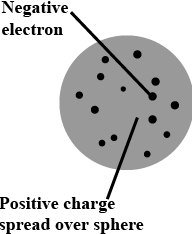
Sir J.J Thomson gave the first model of atom.

He by means of cathode-ray experiment discovered the existence of negatively charged particles in an atom which led to the discovery of electrons.

He gave the plum-pudding model of an atom in which electrons are embedded in atom-like currants.

Positive electrons are distributed all over the atom.
Need a full question paper?

Generate a complete, print-ready paper with questions like this in minutes — across 16+ boards, with answer keys.

Start Generating Free

Similar questions

$\mathop {C{H_3} - CH = O}\limits_{(I)}  \rightleftharpoons \mathop {C{H_2} = CH - OH}\limits_{(II)} $

Between the two tautomers which is more stable ?

On balancing the given redox reaction,

$aCr _2 O _7^{2-}+ bSO _3^{2-}( aq )+ cH ^{+}( aq ) \rightarrow 2 aCr ^{3+}( aq )+ bSO _4^{2-}( aq )+\frac{ c }{2} H _2 O ( l )$

the coefficients a, b and $c$ are found to be, respectively-

In a chemical equilibrium $A + B$ $\rightleftharpoons$ $C + D$, when one mole each of the two reactants are mixed, $0.6 $ mole each of the products are formed. The equilibrium constant calculated is
For the equilibrium $2N{O_2}_{(g)}$ $\rightleftharpoons$ ${N_2}{O_4}_{(g)}$ $ + 14.6\,kcal$ the increase in temperature would
The $pH $ of pure water or neutral solution at $50\,^oC$ is …. $(p{K_w} = 13.26$$ = 13.26$ at $50\,^oC)$
Which of the following has chiral structure
Zinc sulphate contains $22.65\%$ of zinc and $43.9\%$ of water of crystallization. If the law of constant proportions is true, then the weight of zinc required to produce $20\, g$ of the crystals will be ............. $\mathrm{g}$
In the following questions two or more options may be correct:
Which of the following have identical bond order?
Given below are two statements:

Statement $I$ : Nickel is being used as the catalyst for producing syn gas and edible fats.

Statement $II$ : Silicon forms both electron rich and electron deficient hydrides.

In the light of the above statements, choose the most appropriate answer from the options given below:

Hess’s law deals with: