MCQ
The first, second and third ionisation energies  $(E_1 ,E_2$ & $E_3 )$ for an element are  $7\,eV, 12.5\,eV$ and $42.5\,eV$ respectively. The most stable oxidation state of the  element will be
  • A
    $+1$
  • B
    $+4$
  • C
    $+3$
  • $+2$

Answer

Correct option: D.
$+2$
d
The +2 onidation state will be the most stable oridetion state.

It can be seen that $E_{3}$ is very high at 42.5 ev in to $E_{1}(7 eV )$ and $E_{2}$ comparision to $(12.5 eV )$ which implies the element reached a stable electronic configuration at $2^{n d}$ ionization and hence, $E_{3}$ is very high.

Hence, D is the correct anower

Need a full question paper?

Generate a complete, print-ready paper with questions like this in minutes — across 16+ boards, with answer keys.
Start Generating Free

Similar questions

Nitrogen show different oxidation states in the range
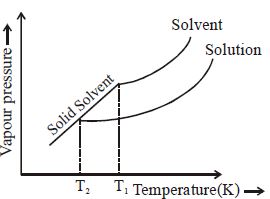
$6\,g$ urea is dissolved in $1\,kg$ solvent. Value of $(T_1-T_2)$ will be .......... $^oC.$ $(K_f = 2\, kg\,K\,mol^{-1})$
Consider the following reaction, $\begin{matrix}
   C{{H}_{3}}-CH-CH-C{{H}_{3}}+\overset{\centerdot }{\mathop{B}}\,r  \\
   |\,\,\,\,\,\,\,\,\,\,\,\,\,\,|\,\,\,\,\,\,\,\,\,\,\,\,\,\,\,\,\,\,\,  \\
   \,\,D\,\,\,\,\,\,\,\,\,C{{H}_{3}}\,\,\,\,\,\,\,\,\,\,\,\,\,\,\,\,  \\
\end{matrix}$ $\to X + HBr$ Indentify the structure of major poroduct $X$
Compound $(B)$ is
Calculate the $\Delta _fH^o$ of $N_2H_4(g)$ if

$B.E(N -N) = 159\, kJ\, mol^{-1}$,

$B.E(H -H) = 436\, kJ\, mol^{-1}$

$B.E.(N \equiv  N) = 941\, kJ\, mol^{-1}$,

$B.E(N -H) = 398\, kJ\, mol^{-1}\, .......\,kJ\, mol^{-1}$

$\mathrm{C}_{6} \mathrm{H}_{5} \mathrm{NO}_{2} \stackrel{\mathrm{Sn}+\mathrm{HCl}}{\longrightarrow}A \,\xrightarrow[\mathrm{{H}^{\oplus}}]{\mathrm{C}_{6} \mathrm{H}_{5} \stackrel{\oplus}{\mathrm{N}}_{2} \stackrel{\Theta}{\mathrm{Cl}}}P$

$\quad\quad\quad\quad\quad\quad\quad\quad\quad\quad\quad\quad\quad$(Yellow coloured compound)

Consider the above reaction, the Product $"P"$ is:

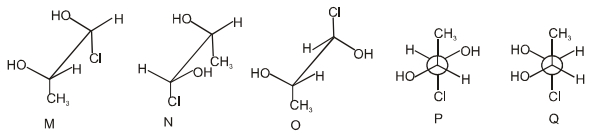
Which of the given statement$(s)$ about $N , O , P$ and $Q$ with respect to $M$ is (are) correct?.

$(A)$ $M$ and $N$ are non-mirror image stereoisomers

$(B)$ $M$ and $O$ are identical

$(C)$ $M$ and $P$ are enantiomers

$(D)$ $M$ and $Q$ are identical
The rate constant for a first order reaction is $20\,min ^{-1}$. The time required for the initial concentration of the reactant to reduce to its $\frac{1}{32}$ level is $........\times 10^{-2}\,min$. (Nearest integer)(Given: $\quad \ln 10=2.303, \log 2=0.3010)$
An aqueous solution whose $pH = 0$ is
Which one of the following statements is correct?