Question
The following compound can exhibits
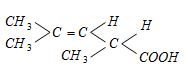
$\begin{array}{*{20}{c}}
{\,\,\,\,\,\,\,\,\,\,\,\,\,\,\,\,\,\,\,\,\,\,\,\,\,\,\,\,\,\,\,H} \\
{\,\,\,\,\,\,\,\,\,\,\,\,\,\,\,\,\,\,\,\,\,\,\,\,\,\,\,\,|} \\
{{{(C{H_3})}_2} - C = CH - {C^*} - COOH} \\
{\,\,\,\,\,\,\,\,\,\,\,\,\,\,\,\,\,\,\,\,\,\,\,\,\,\,\,|\,} \\
{\,\,\,\,\,\,\,\,\,\,\,\,\,\,\,\,\,\,\,\,\,\,\,\,\,\,\,\,\,C{H_3}}
\end{array}$
Generate a complete, print-ready paper with questions like this in minutes — across 16+ boards, with answer keys.
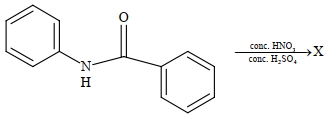
A current was passed for $10$ hours. $10.8\ g Ag$ was deposited at cathode in $(III)$ electrolytic cell during electrolysis if current efficiency is $50\%.$
If $Z_1,$ $Z_2$ and $Z_3$ be the electrochemical equivalent in the formation of $H_2, Cu$ and $Ag$ respectively, hence $Z_1 : Z_2 : Z_3$ would be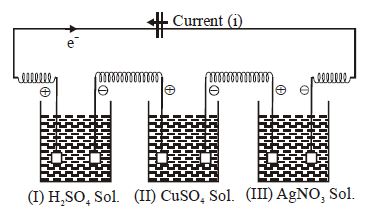
$(i)$ $\begin{array}{*{20}{c}}
{\begin{array}{*{20}{c}}
{\,\,\,\,\,\,\,\,\,\,\,\,\,\,\,\,\,\,\,\,\,\,\,\,\,\,\,\,\,\,\,\,\,\,\,\,\,\,\,\,C{H_3}-CH_2} \\
{\,\,\,\,\,\,\,\,\,\,\,\,\,|}
\end{array}} \\
{C{H_3} - {C^ + }} \\
{\,\,\,\,\,\,\,\,\,\,\,\,\,\,|} \\
{\,\,\,\,\,\,\,\,\,\,\,\,\,\,\,\,\,\,\,\,\,C{H_3}}
\end{array}$
$(ii)$ $\begin{array}{*{20}{c}}
{\begin{array}{*{20}{c}}
{\,\,\,\,\,\,\,\,\,\,\,\,\,\,\,\,\,\,\,\,\,\,C{H_3}} \\
{\,\,\,\,\,\,\,\,\,\,\,\,\,|}
\end{array}} \\
{C{H_3} - {C^ + }} \\
{\,\,\,\,\,\,\,\,\,\,\,\,\,\,|} \\
{\,\,\,\,\,\,\,\,\,\,\,\,\,\,\,\,\,\,{H}}
\end{array}$
$(iii)$ $\begin{array}{*{20}{c}}
{\begin{array}{*{20}{c}}
{\,\,\,\,\,\,\,\,\,\,\,\,\,\,\,\,\,\,\,C{H_3}} \\
{\,\,\,\,\,\,\,\,\,\,\,\,\,|}
\end{array}} \\
{C{H_3} - {C^ + }} \\
{\,\,\,\,\,\,\,\,\,\,\,\,\,\,|} \\
{\,\,\,\,\,\,\,\,\,\,\,\,\,\,\,\,\,\,\,\,\,C{H_3}}
\end{array}$
$(iv)$ $Ph - CH ^{+}-\underline{ CH }_{3}$
$SF _{4}, BF _{4}^{-}, CIF _{3}, AsF _{3}, PCl _{5}, BrF _{5}, XeF _{4}, SF _{6}$