The following four wires are made of the same material and are at the same temperature. Which one of them has highest electrical resistance
Easy


Download our appand get started for free
Experience the future of education. Simply download our apps or reach out to us for more information. Let's shape the future of learning together!No signup needed.*
Similar Questions
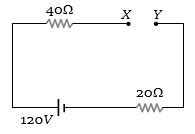
- 1Potential difference across the $40\,\Omega $ resistance will be ............ $V$View Solution
- 2In an experiment to find $emf$ of a cell using potentiometer, the length of null point for a cell of emf $1.5\,V$ is found to be $60\,cm$. If this cell is replaced by another cell of $emf\; E$. the length-of null point increases by $40\,cm$. The value of $E$ is $\frac{x}{10} V$. The value of $x$ is $............$View Solution
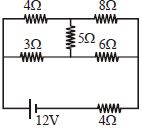
- 3In the given figure the ratio of current in $8\,\Omega $ and $3\,\Omega $ will beView Solution
- 4A technician has only two resistance coils. By using them singly, in series or in parallel, he is able to obtain the resistance $3,4,12$ and $16 \,ohms$. The resistance of the two coils are ........... $ohms$View Solution
- 5View SolutionA thick wire is stretched so that its length become two times. Assuming that there is no change in its density, then what is the ratio of change in resistance of wire to the initial resistance of wire
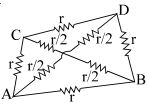
- 6The figure shows a tetrahedron, each side of which has a resistance $r$ If a battery is connected between any two points of the tetrahedron, then identify the correct statement $(s)$.View Solution
- 7When two resistance are connected in parallel then the equivalent resistance is $\frac {6}{5}\Omega $ . When one of the resistance is removed then the effective resistance is $2\, \Omega $. The resistance of the wire removed will be ................ $\Omega$View Solution
- 8View SolutionThe specific resistance of all metals is most affected by
- 9Two conductors made of the same material are connected across a common potential difference. Conductor $A$ has twice the diameter and twice the length of conductor $B$. The power delivered to the two conductors ${P_A}$ and ${P_B}$ respectively is such that ${P_A}/{P_B}$ equals toView Solution
- 10Two wires have resistance of $2$ $\Omega$ and $4$ $\Omega$ connected to same voltage, ratio of heat dissipated at resistance isView Solution