The following four wires are made of the same material. Which of these will have the largest extension when the same tension is applied?
AIPMT 2013, Medium


Download our appand get started for free
Experience the future of education. Simply download our apps or reach out to us for more information. Let's shape the future of learning together!No signup needed.*
Similar Questions
- 1A wire of area of cross-section ${10^{ - 6}}{m^2}$ is increased in length by $0.1\%$. The tension produced is $1000 N$. The Young's modulus of wire isView Solution
- 2View SolutionThe Poisson's ratio cannot have the value
- 3The area of cross section of a steel wire $(Y = 2.0 \times {10^{11}}N/{m^2})$ is $0.1\;c{m^2}$. The force required to double its length will beView Solution
- 4A wire of length $L,$ area of cross section $A$ is hanging from a fixed support. The length of the wire changes to $L_{1}$ when mass $M$ is suspended from its free end. The expression for Young's modulus isView Solution
- 5A wire can be broken by applying a load of $200\, N$. The force required to break another wire of the same length and same material, but double in diameter, is .......... $N$View Solution
- 6A wire of length $L$ and radius $r$ is clamped rigidly at one end. When the other end of the wire is pulled by a force $f$, its length increases by $l$. Another wire of same material of length $2 L$ and radius $2 r$ is pulled by a force $2 f$. Then the increase in its length will beView Solution
- 7A wire of length $50\, cm$ and cross sectional area of $1$ sq. mm is extended by $1\, mm.$ The required work will be $(Y = 2 \times {10^{10}}\,N{m^{ - 2}})$View Solution
- 8Two wire $A$ and $B$ are stretched by same force. If, for $A$ and $B, Y_A: Y_B=1: 2, r_A: r_B=3: 1$ and $L_A: L_B=4: 1$, then ratio of their extension $\left(\frac{\Delta L_A}{\Delta L_B}\right)$ will be .............View Solution
- 9If the potential energy of a spring is $V$ on stretching it by $2\, cm$, then its potential energy when it is stretched by $10 \,cm$ will beView Solution
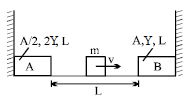
- 10In the given figure, two elastic rods $A$ & $B$ are rigidly joined to end supports. $A$ small mass $‘m’$ is moving with velocity $v$ between the rods. All collisions are assumed to be elastic & the surface is given to be frictionless. The time period of small mass $‘m’$ will be : [$A=$ area of cross section, $Y =$ Young’s modulus, $L=$ length of each rod ; here, an elastic rod may be treated as a spring of spring constant $\frac{{YA}}{L}$ ]View Solution