A wire of length $L,$ area of cross section $A$ is hanging from a fixed support. The length of the wire changes to $L_{1}$ when mass $M$ is suspended from its free end. The expression for Young's modulus is
NEET 2020, Easy


Download our appand get started for free
Experience the future of education. Simply download our apps or reach out to us for more information. Let's shape the future of learning together!No signup needed.*
Similar Questions
- 1A wire of cross-sectional area $3\,m{m^2}$ is first stretched between two fixed points at a temperature of $20°C$. Determine the tension when the temperature falls to $10°C$. Coefficient of linear expansion $\alpha = {10^{ - 5}} { ^\circ}{C^{ - 1}}$ and $Y = 2 \times {10^{11}}\,N/{m^2}$ ........ $N$View Solution
- 2View SolutionStress to strain ratio is equivalent to
- 3Given : $\sigma$ is the compressibility of water, $\rho$ is the density of water and $K$ is the bulk modulus of water. What is the energy density of water at the bottom of a lake $‘h’$ metre deep ?View Solution
- 4The bulk modulus of a gas is defined as $B=-V d p / d V$. For an adiabatic process the variation of $B$ is proportional to $p^n$. For an ideal gas $n$ isView Solution
- 5If the Bulk modulus of lead is $8.0 \times 10^9 \,N / m ^2$ and the initial density of the lead is $11.4 \,g / cc$, then under the pressure of $2.0 \times 10^8 \,N / m ^2$, the density of the lead is $.............g / cc$View Solution
- 6$A$ current of $(2.5 \pm 0.05)$ $A$ flows through a wire and develops a potential difference of $(10 \pm 0.1)$ $\mathrm{volt}.$ Resistance of the wire in $\mathrm{ohm},$ isView Solution
- 7View SolutionThe ratio of the adiabatic to isothermal elasticities of a triatomic gas is
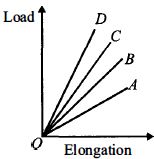
- 8View SolutionThe load versus elongation graphs for four wires of same length and made of the same material are shown in the figure. The thinnest wire is represented by the line
- 9Two separate wires $A$ and $B$ are stretched by $2 \,mm$ and $4\, mm$ respectively, when they are subjected to a force of $2\, N$. Assume that both the wires are made up of same material and the radius of wire $B$ is 4 times that of the radius of wire $A$. The length of the wires $A$ and $B$ are in the ratio of $a : b$. Then $a / b$ can be expressed as $1 / x$ where $x$ isView Solution
- 10View SolutionUnder elastic limit the stress is