MCQ
The following four wires are made of the same material. Which of these will have the largest extension when the same tension is applied?
  • length $ =50 \;cm$,diameter $=0.5\; mm$
  • B
    length $=100 \;cm$,diameter $=1 \;mm$
  • C
    length $= 200\; cm$,diameter $= 2 \;mm$
  • D
    length $= 300\; cm$,diameter $= 3\; mm$

Answer

Correct option: A.
length $ =50 \;cm$,diameter $=0.5\; mm$
a
Young's modulus,

$Y = \frac{{FL}}{{A\Delta L}} = \frac{{4FL}}{{\pi {D^2}\Delta L}}\,\,or\,\,\Delta L = \frac{{4FL}}{{\pi {D^2}Y}}$

Where $F$ is the force applied, $L$ is the length, $D$ is the diameter and $\Delta L$ is the extension of the wire respectively. 

As each wire is made up of same material therefore their $Young's$ modulus is same for each wire.

Foe all the four wires, $Y,F\,(=tension)$ are the same.

$\therefore \Delta L \propto \frac{L}{{{D^2}}}$

$In\,\,\left( a \right)\,\,\frac{L}{{{D^2}}} = \frac{{200\,cm}}{{{{\left( {0.2\,cm} \right)}^2}}} = 5 \times {10^3}\,c{m^{ - 1}}$

$In\,\,\left( b \right)\,\,\,\frac{L}{{{D^2}}} = \frac{{300\,cm}}{{{{\left( {0.3\,cm} \right)}^2}}} = 3.3 \times {10^3}\,c{m^{ - 1}}$

$In\,\,\left( c \right)\,\,\frac{L}{{{D^2}}} = \frac{{50\,cm}}{{{{\left( {0.05\,cm} \right)}^2}}} = 20 \times {10^3}\,c{m^{ - 1}}$

$In\,\,\left( d \right)\,\,\frac{L}{{{D^2}}} = \frac{{100\,cm}}{{{{\left( {0.1\,cm} \right)}^2}}} = 10 \times {10^3}\,\,c{m^{ - 1}}$
Need a full question paper?

Generate a complete, print-ready paper with questions like this in minutes — across 16+ boards, with answer keys.

Start Generating Free

Similar questions

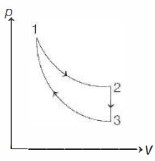
The three processes in a thermodynamic cycle shown in the figure are : Process $1 \rightarrow 2$ is isothermal; Process $2 \rightarrow 3$ is isochoric (volume remains constant); Process $3 \rightarrow 1$ is adiabatic. The total work done by the ideal gas in this cycle is $10 \,J$. The internal energy decreases by $20 \,J$ in the isochoric process. The work done by the gas in the adiabatic process is $-20 \,J$. The heat added to the system in the isothermal process is .............. $J$
The net resistance of an ammeter should be small to ensure that:
A point mass is subjected to two simultaneous sinusoidal displacements in x-direction, $x_1(t)=A \sin \omega t $ and $ x_2(t)=A \sin \left(\omega t+\frac{2 \pi}{3}\right)$. Adding a third sinusoidal displacement $x_3(t)=B \sin (\omega t+\phi)$ brings the mass to a complete rest. The values of $B$ and $\phi$ are
A ball is thrown up at an angle with the horizontal. Then, the total change of momentum by the instant it returns to the ground is
The mass of a particle is $1\,\,kg$ and it is moving along  $x-$ axis. The period of its small oscillation is $\frac {\pi }{2}$ . Its potential energy may be
Two satellites $A$ and $B$ go round a planet in circular orbits having radii $4R$ and $R$, respectively. If the speed of satellite $A$ is $3v$, then speed of satellite $B$ is
At any instant of time $t$, the displacement of any particle is given by $2 t-1$ ($SI$ unit) under the influence of force of $5 \mathrm{~N}$. The value of instantaneous power is (in SI unit):
$A$ and $B$ are two wires. The radius of $A$ is twice that of $B.$ They are stretched by the some load. Then the stress on $B$ is
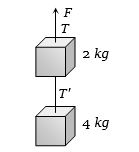
Two blocks are connected by a string as shown in the diagram. The upper block is hung by another string. A force $F$ applied on the upper string produces an acceleration of $2\,m/{s^2}$ in the upward direction in both the blocks. If $T$ and $T'$ be the tensions in the two parts of the string, then $T$ and $T'$
A light spring balance hangs from the hook of the other light spring balance and a block of mass $M$ kg hangs from the former one. Then the true statement about the scale reading is