Question
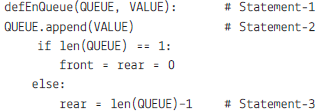
The following is the code related to the data structure QUEUE

Now answer the following based on the code given:

(a) What is the purpose of EnQueue function

(# Statement-1) defined above:

(i) It is a user defined function to scan / access QUEUE elements

(ii) It is a pre defined function to scan / access QUEUE elements

(iii) It is a user defined function working on double ended queue

(iv) It is a user defined function working on circular queue

(b) What is the line QUEUE.append(VALUE)

(# Statement-2) doing

(i) This will add the element at the end of the QUEUE

(ii) This will remove the element from the end of the QUEUE

(iii) This will add the element at the beginning of the QUEUE

(iv) This will remove the element from the beginning of the QUEUE

(c) Conceptually if the QUEUE is already full , what will happen

(i) PEEK() function will be executed

(ii) OVERFLOW occurs

(iii) UNDERFLOW occurs

(iv) We may still add more elements in it.

(d) What is the use of the variable VALUE used in argument (# Statement-1)

(i) This is the position of FRONT

(ii) This is the position of REAR

(iii) This is an element added in a QUEUE

(iv) This is the name of the list

(e) When the else part (# Statement-3) of the above code will be executed

(i) When the length of the QUEUE is zero

(ii) When the length of the QUEUE is one

(iii) When the length of the QUEUE is more than one

(iv) This part of the code will always executed
Answer

(a) (i) It is a user defined function to scan / access QUEUE elements

(b) (iii) This will add the element at the beginning of the QUEUE

(c) (ii) OVERFLOW occurs

(d) (iii) This is an element added in a QUEUE

(e) (iii) When the length of the QUEUE is more than one

Need a full question paper?

Generate a complete, print-ready paper with questions like this in minutes — across 16+ boards, with answer keys.

Start Generating Free

Similar questions

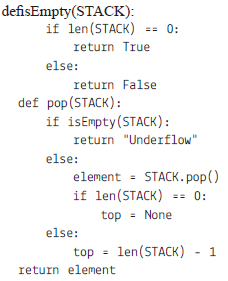
Read the following code carefully which is implementing the concept of STACK:

Now answer the following based on the code given:

(a) How are the above two functions interrelated?

(i) The function isEmpty(STACK) will be called when pop(STACK) is called

(ii) The function pop(STACK) will be called when is Empty(STACK) is called

(iii) Both functions are implementing recursion

(iv) These functions are not related to each other.

(b) What is the difference in between STACK.pop() and pop(STACK)

(i) Both are pre-defined functions

(ii) Both are user-defined functions

(iii) STACK.pop() is pre defined and pop(STACK) is user defined

(iv) STACK.pop() is user defined and pop(STACK) is pre defined

(c) What is the return type of the function defisEmpty (STACK)

(i) None (ii) void

(iii) int (iv) Boolean

(d) What will the pop(STACK) function return if the stack already consist of [‘A’,’B’] at the position 0 and 1 respectively

(i) A (ii) B (iii) Both A and B (iv) None

(e) if len(STACK) == 0: What is the purpose of this line in the above code:

(i) It checks if the stack is already full

(ii) It checks if the stack can add more value in it or not

(iii) It checks if the stack is already empty

(iv) It checks if the stack exist or not

Write SQL commands for (a) to (f) and write the outputs for (g) on the basis of tables FURNITURE and ARRIVALS

Table: FURNITURE

NO ITEMNAME TYPE DATEOFSTOCK PRICE DISCOUNT
1 White lotus Double Bed 23/02/2002 30000 25
2 Pink feather Baby cot 20/01/2002 7000 20
3 Dolphin Baby cot 19/02/2002 9500 20
4 Decent Office Table 01/01/2002 25000 30
5 Comfort zone Double Bed 12/01/2002 25000 25
6 Donald Baby cot 24/02/2002 6500 15
7 Royal Finish Office Table 20/02/2002 18000 30
8 Royal tiger Sofa 22/02/2002 31000 30
9 Econo sitting Sofa 13/12/2001 9500 25
10 Eating Paradise Dining Table 19/02/2002 11500 25

Table: ARRIVALS

NO ITEMNAME TYPE DATEOFSTOCK PRICE DISCOUNT
1 Wood Comfort Double Bed 23/03/2003 25000 25
2 Old Fox Sofa 20/02/2003 17000 20
3 Micky Baby cot 21/02/2003 7500 15

(a) To show all information about the Baby cots from the FURNITURE table.

(b) To list the ITEMNAME which are priced at more than 15000 from the FURNITURE table.

(c) To list ITEMNAME and TYPE of those items, in which date of stock is before 22/01/2002 from the FURNITURE table in descending order of ITEMNAME.

(d) To display ITEMNAME and DATEOFSTOCK of those items, in which the discount t percentage is more than 25 from FURNITURE table.

(e) To count the number of items, whose TYPE is “Sofa” from FURNITURE table.

(f) To insert a new row in the ARRIVALS table with the following data:

14,“Valvet touch”, “Double bed”, {25/03/03}, 25000,30

(g) Give the output of following SQL statement

Note: Outputs of the above mentioned queries should be based on original data given in both the tables i.e., without considering the insertion done in

(f) part of this question.

(i) Select COUNT(distinct TYPE) from FURNITURE;

(ii) Select MAX(DISCOUNT) from FURNITURE, ARRIVALS;

(iii) Select AVG(DISCOUNT) from FURNITURE where TYPE=”Baby cot”;

(iv) Select SUM(Price) from FURNITURE where DATEOFSTOCK<12/02/02;

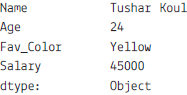
Consider the following Data Frame ‘‘emp’’ and answer any four questions from (i) – (v).

Ecode Name Age Fav_Color Salary
101 Rohit 20 Blue 45000
102 Mohanti 24 Red 36000
103 Tushar Koul 23 Green 42000
104 Rupali 22 Yellow 38000
105 Gurpreet 21 Pink 40000

(a) Select the command from the given options that will give the following output:-

(i) print(emp.max)

(ii) print(emp.max(axis=1))

(iii) print(emp.max,axis=1)

(iv) print(emp.max())

(b) A manager wants to know the Favourite colour of the employee with the employee code 103. Help him to identify the correct set of statements from the given options:

(i) df1=emp[emp[‘Ecode’]==103]

print(df1)

(ii) df1=emp['Ecode'==103]

print(df1)

(iii) df1=emp[emp.Ecode=103]

print(df1)

(iv) df1=emp[emp.Ecode==103]

print(df1)

(c) Which of the following statement will give the names of the employees whose salary is more than 40000.

(i) print(emp.max())

(ii) print(emp[emp["Salary"]>40000])

(iii) print(emp["Salary"]>40000)

(iv) print(emp.max()>40000)

(d) Which of the following command will list only the columns Ename and Salary using loc:

(i) print(emp.loc[:,[0,2]]

(ii) print(emp.loc[:,["Ename","Salary"]])

(iii) print(emp.loc(:["Ename","Salary"]))

(iv) print(emp.loc[["Ename","Salary"]])

(e) Mr. Singh, the manager wants to add a new column, the Rank with the values ‘IV’, ‘II’, ‘III’, ‘IV’, ‘I’, to the data frame Help him to identify the right command from the followings to do so :

(i) emp.column=[‘IV’, ‘II’, ‘III’, ‘IV’, ‘I’ ]

(ii) emp.iloc["Rank"] =[‘IV’, ‘II’, ‘III’, ‘IV’, ‘I’]

(iii) emp["Rank"] =[‘IV’, ‘II’, ‘III’, ‘IV’, ‘I’ ]

(iv) None of the above

“IT Tech ”Company conducts workshops for employees of organizations. The company requires data of workshops that are organize(d) As a database administrator you have decided that:

Name of the Database: IT

Name of the Table: WORKSHOP

Attributes of Table ‘Workshop ’are as follows.

Field Type Constraint
Workshopld integer Primary Key
Title Varchar(50)
DateWorkshop Date
NumSpeakers Integer

Table : WORKSHOP

WorkshopId Title Date Workshop NumSpeakers
1001 Robotics 2020-02-21 3
1002 AI 2020-05-24 4
1003 Humanoids 2020-07-15 3
1004 Block Chain 2020-04-25 5
1005 Cloud 2020-03-03 4

(a) Which attribute can be the primary key.

(i) Title (ii) WorkshopID

(iii) NumSpeaker (iv) DateWorkshop

(b) Which command will display the structure of the table:

(i) Use workshop (ii) Desc

(iii) Desc workshop (iv) Show tables

(c) Command to display all the record in descending order of number of speakers.

(i) Select * from Workshop reverse by NumSpeakers;

(ii) Select * from workshop order by descNumSpeakers;

(iii) Select * from workshop order by NumSpeakersdesc;

(iv) Select * from workshop group by NumSpeakersdesc;

(d) What will be the cardinality and degree of the table: WORKSHOP

(i) Cardinality = 5, Degree =4

(ii) Cardinality = 4, Degree =5

(iii) Cardinality = 6, Degree =4

(iv) Cardinality = 5, Degree =5

(e) Choose the right command which will delete the record of 1004 WorkshopId

(i) Delete * from workshop where workshopid==1004;

(ii) Delete from workshop where workshopid=1004;

(iii) Drop from workshop where workshopid=1004;

(iv) Delete table from workshop where workshopid=1004;

Consider the table LOANS given below:

Table: LOANS

AccNo Name Loan Amt EMI IntRate Start Date Interest
1001 R.K. Gupta 300000 36 12.00 19-07-2009 1200
1002 S. P. Shanna 500000 48 10.00 22-03-2008 1800
1003 K.P. Jain 300000 36 NULL 08-03-2007 1600
1004 M.P. Yadav 800000 60 10.00 06-12-2008 2250
1005 S.P. Sinlia 200000 36 12.50 03-01-2010 4500
1006 P. Shanna 700000 60 12.50 05-06-2008 3500
1007 K.S. Dhall 500000 48 NULL 05-03-2008 3800

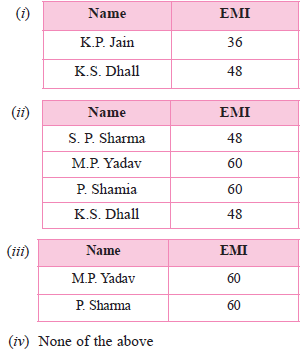
(a) State the command that will give the output as:

Name
S. P. Shanna
K.S. Dhall
M.P. Yadav
P. Shanna
K.S. Dhall

(i) Select name from LOANS where Name >‘D ’;

(ii) Select name from LOANS where AccNo >1001;

(iii) Select name from LOANS where Loan_Amt >= 500000;

(iv) Select name from LOANS where Loan_Amt >500000 order Loan_AmtDESC;

(b) What will be the output of the following command:

Select name, EMI from LOANS where Loan_Amt >500000 and Int_Rate is NULL;

(c) John has given the following command to display the count of all loan holders whose name ends with “Sharma ”:

Select count() from LOANS where Name like ‘Sharma%’;

But he is not getting the desired result. Help him by finding out the correct command fromthe followings:

(i) Select count(*) from LOANS where name Like ‘Sharma%’;

(ii) Select count(*) from LOANS where name Like ‘%Sharma ’;

(iii) Select count( ) from LOANS where name like ‘%sharma ’;

(iv) Select count(Name) from LOANS where name ‘Sharma%’;

(d) State the command to display the maximum Loan_Amt and Cust_Name :-

(i) Select Max(Cust_Name, Loan_Amt) from LOANS;

(ii) Select Cust_Name, max(LoanAmt) from LOANS;

(iii) Select Cust_Name, max(Loan_Amount) from LOANS;

(iv) Select Cust_name, max(Loan_Amt) from LOANS;

(e) Help Ramesh to display the count of all loan holders whose interest is NULL.

(i) Select Count(*) from LOANS where Int_Rate is NULL.

(ii) Select Count() from LOANS where Interest is NULL.

(iii) Select Count(*) from LOANS where Int_rate = NULL;

(iv) Select Count( ) from LOANS where Interest = NULL;

Consider the following table Student & Stream.

Table: Student

Admno Sname Class Sec Fee Mobile Area S_ID
1001 RAMESH XII A 2500 987654321 Madipur 10
1078 KRISHNA XII B 2400 999911111 Jawala Heri 30
1006 FARDEEN XII C 2600 987654321 Paschim Puri 40
1004 SUBHAM XII A 2500 963025874 Madipur 20
1029 KRITIKA XI C 2700 987456210 Madipur 30
1008 SAMEEKSHA XII A 2450 987123456 Mangol Puri 20
1025 SALMA XII B 2580 998877445 Madipur 30
1036 AMANDEEP XII B 2600 999333555 Khyala 40
1037 TEJAS XI C 2650 987951357 Paschim Puri 40
1029 HIMANSHU XII A 2750 951369874 Jawala Heri 10

Table : Stream

S_ID Stream_name
10 MEDILCAL
20 NON MEDICAL
30 COMMERCE WITH MATH
40 COMMERCE WITH IP
50 HUMANITIES

Write SQL commands for the statements (a) to (h) on the table: Student and Stream

(a) Display class and total fee collected from each class.

(b) Display admission no, students name and stream name.

(c) Display all the student details who have taken Commerce Stream.

(d) Count number of students who have opted for HUMANITIES stream.

(e) Display information of commerce with ip students whose name start with ‘S’. Arrange the record by admission number.

(f) Display details of all students who are in the MEDICAL stream.

(g) Display total fee of ‘Non-Medical’ Student.

(h) Change the name of the Column Sname to Student_Name.

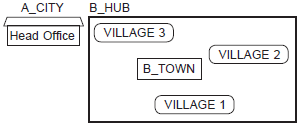
Uplifting Skills Hub India is a knowledge and skill community which has an aim to uplift the standard of knowledge and skills in the society. It is planning to setup its training centers in multiple towns and villages pan India with its head offices in the nearest cities. They have created a model of their network with a city, a town and 3 villages as follows.

As a network consultant, you have to suggest the best network related solutions for their issues/problems raised in (a) to (d) keeping in mind the distances between various locations and other given parameters.

Shortest distances between various locations:

VILLAGE 1 to B_TOWN 2 KM
VILLAGE 2 to B_TOWN 1.0 KM
VILLAGE 3 to B_TOWN 1.5 KM
VILLAGE 1 to VILLAGE 2 3.5 KM
VILLAGE 1 to VILLAGE 3 4.5 KM
VILLAGE 2 to VILLAGE 3 2.5 KM
A_CITY Head Office to B_HUB 25 KM

Number of Computers installed at various locations are as follows:

B_TOWN 120
VILLAGE 1 15
VILLAGE 2 10
VILLAGE 3 15
A_CITY OFFICE 6

Note:

• In Villages, there are community centers, in which one room has been given as training center to this organization to install computers.
• The organization has got financial support from the government and top IT companies.

(a) Suggest the most appropriate location of the SERVER in the B_HUB (out of the 4 locations), to get the best and effective connectivity. Justify your answer.

(b) Suggest the best wired medium and draw the cable layout (location to location) to efficiently connect various locations within the B_HUB.

(c) Which hardware device will you suggest to connect all the computers within each location of B_HUB?

(d) Which service/protocol will be most helpful to conduct live interactions of Experts from Head Office and people at all locations of B_HUB?

Write SQL queries for (i) to (iv) and find outputs for SQL queries (v) to (vii), which are based on the tables. [CBSE Sample Paper 2018]

Table: Trainer

TID Tname City HireDate Salary
101 Sunaina Mumbai 1998-10-15 90000
102 Anamika Delhi 1994-12-24 80000
103 Deepti Chandigarh 2001-12-21 82000
104 Meenakshi Delhi 2002-12-25 78000
105 Richa Mumbai 1996-01-12 95000
106 Maniprabha Chennai 2001-12-12 69000

Table: Course

CID CNAME FEES STARTDATE TID
C201 AGDCA 12000 2018-07-02 101
C202 ADCA 15000 2018-07-15 103
C203 DCA 10000 2018-10-01 102
C203 DDTP 9000 2018-09-15 104
C205 DHN 20000 2018-08-01 101
C206 O LEVEL 18000 2018-07-25 105

(a) Display the Trainer Name, City and Salary in descending order of their hire date.

(b) To display the TNAME and CITY of Trainer of joined the institute in the month of December 2001.

(c) To display TNAME, HIREDATE,CNAME, STARTDATE from tables TRAINER and COURSE whose FEES is less than or equal to 10000

(d) To display number of trainer from each city (e) select tid, tname,from trainer where city not in(‘delhi’,’mumbai’);

(f) select distinct tid from course;

(g) select tid , count (*), min(fees) from course group by tid having count(*)>1;

(h) Select count(*),sum(fees) from course where startdate <’2018-09-15’;

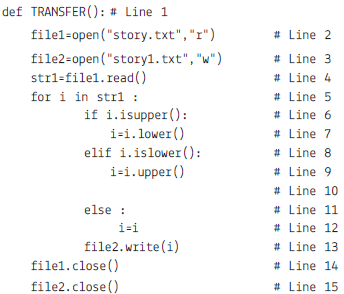
Krishna is confused in Python code given below. Please help him to answer the following questions.

(a) Which line in the above code check for capital letter?

(b) Which line in the above code read the file “story. txt”?

(c) Which line in the above code does not affect the execution of program?

(d) Which line is the above code coverts capital letter to small letter?

(e) Which line is the above code opens the file in write mode?

(f) Which line is the above code saves the data?

(g) Which line(s) is/are the part of selection statement.

(h) Which line(s) is/are used to close story1.txt?

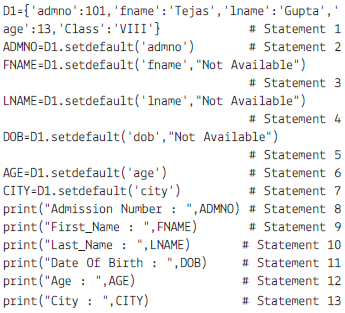
Pawan is confused in understanding Dictionary concept. Help him to understand the concept by choosing the appropriate answer.

(a) Which statement will display Not Available?

(i) Statement 9 (ii) Statement 10

(iii) Statement 11 (iv) Statement 13

(b) Choose the key from Dictionary.

(i) ADMNO (ii) ‘admno ’

(iii) 101 (iv) “Not Available ”

(c) Which statement will display None?

(i) Statement 9 (ii) Statement 10

(iii) Statement 11 (iv) Statement 13

(d) Which Statement will display Tejas?

(i) Statement 8 (ii) Statement 9

(iii) Statement 10 (iv) Statement 11

(e) Choose the identifier.

(i) ADMNO (ii) ‘admno ’

(iii) setdefault (iv) Not Available