Question
The following phenomenon cannot be observed for sound waves

Answer

(d)Sound waves are longitudinal in nature so they can not be polarised

Need a full question paper?

Generate a complete, print-ready paper with questions like this in minutes — across 16+ boards, with answer keys.
Start Generating Free

Similar questions

A stone is dropped from a height $h.$ It hits the ground with a certain momentum $P.$ If the same stone is dropped from a height $100\%$ more than the previous height, the momentum when it hits the ground will change by  ........... $\%$
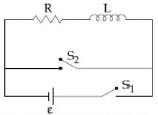
In the circuit shown, The switch $S_1$ is close at time $t = 0$ and the switch $S_2$ is kept open. At some later time $(t_0)$ the switch $S_1$ is opened and $S_2$ is closed. The behaviour of the current $I$ as a function of time $‘t’$ is given by
Which of the following statement is true
The temperatures inside and outside of a refrigerator are 273 K and 303 K respectively. Assuming that the refrigerator cycle is reversible, for every joule of work done, the heat delivered to the surroundings will be near:
Two coils of self inductance $100\,mH$ and $400\,mH$ are placed very close to each other. Find the maximum mutual inductance between the two when $8\,A$ current passes through them.......$mH$
Assertion : In a cavity within a conductor, the electric field is zero.

Reason : Charges in a conductor reside only at its surface

Area of the cross-section of a wire is measured using a screw gauge. The pitch of the main scale is $0.5 mm$. The circular scale has 100 divisions and for one full rotation of the circular scale, the main scale shifts by two divisions. The measured readings are listed below.

Measurement condition Main scale reading Circular scale reading
Two arms of gauge touching each other without wire $0$  division $4$ division
Attempt-$1$: With wire $4$  division $20$ division 
Attempt-$2$: With wire $4$ division $16$ division

What are the diameter and cross-sectional area of the wire measured using the screw gauge?

A particle of mass $m$ undergoes oscillations about $x=0$ in a potential given by $V(x)-\frac{1}{2} k x^2-V_0 \cos \left(\frac{x}{a}\right)$, where $V_0, k, a$ are constants. If the amplitude of oscillation is much smaller than $a$, the time period is given by
In Young’s experiment, the ratio of maximum to minimum intensities of the fringe system is $4 : 1$. The amplitudes of the coherent sources are in the ratio
Which source is associated with a line emission spectrum