A particle of mass $m$ undergoes oscillations about $x=0$ in a potential given by $V(x)-\frac{1}{2} k x^2-V_0 \cos \left(\frac{x}{a}\right)$, where $V_0, k, a$ are constants. If the amplitude of oscillation is much smaller than $a$, the time period is given by
KVPY 2010, Advanced
Download our app for free and get started
(a)
Force on the particle is $F=-\frac{d V}{d x}$
$\Rightarrow \quad F=-\frac{d}{d x}\left(\frac{1}{2} k x^2-V_o \cos \left(\frac{x}{a}\right)\right)$
$=-\left(k x+\frac{V_o}{a} \sin \left(\frac{x}{a}\right)\right)$
As $\quad x << a, \Rightarrow \frac{x}{a} << 1$
So, $\sin \frac{x}{a} \approx \frac{x}{a}$
Hence, $F=-\left(k x+\frac{V_0}{a} \cdot \frac{x}{a}\right)=-\left(k+\frac{V_0}{a^2}\right) \cdot x$
Acceleration $A$ of the particle is
$A=\frac{F}{m}=-\frac{1}{m}\left(k+\frac{V_{0}}{a^2}\right) \cdot x$
As, acceleration $A=-\omega^2 x$, we have
$c 0=\sqrt{\frac{1}{m}\left(k+\frac{V_0}{a^2}\right)}=\sqrt{\left(\frac{k a^2+V_0}{m a^2}\right)}$
$\therefore$ Time period of oscillation is
$T=\frac{2 \pi}{\omega}=2 \pi \sqrt{\left(\frac{m a^2}{k a^2+V_0}\right)}$

Download our appand get started for free
Experience the future of education. Simply download our apps or reach out to us for more information. Let's shape the future of learning together!No signup needed.*
Similar Questions
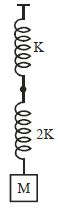
- 1Two springs of force constant $K$ and $2K$ are connected to a mass as shown below. The frequency of oscillation of the mass isView Solution
- 2There is a simple pendulum hanging from the ceiling of a lift. When the lift is stand still, the time period of the pendulum is $T$. If the resultant acceleration becomes $g/4,$ then the new time period of the pendulum isView Solution
- 3A simple pendulum is hanging from a peg inserted in a vertical wall. Its bob is stretched in horizontal position from the wall and is left free to move. The bob hits on the wall the coefficient of restitution is $\frac{2}{{\sqrt 5 }}$. After how many collisions the amplitude of vibration will become less than $60°$View Solution
- 4The potential energy of a particle of mass $1\, kg$ in motion along the $x-$ axis is given by $U = 4\,(1 -cos\,2x)$, where $x$ is in $metres$ . The period of small oscillation (in $second$ ) isView Solution
- 5For a particle showing motion under the force $F=-5(x-2)^2$, the motion is .......View Solution
- 6Two particles $P$ and $Q$ describe $SHM$ of same amplitude $a$ , frequency $v$ along the same straight line. The maximum distance between the two particles is $a \sqrt 2$ . The initial phase difference between the particles isView Solution
- 7Starting from the origin a body oscillates simple harmonically with a period of $2\ s$. After what time will its kinetic energy be $75\%$ of the total energy?View Solution
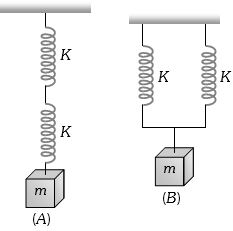
- 8Two identical spring of constant $K$ are connected in series and parallel as shown in figure. A mass $m$ is suspended from them. The ratio of their frequencies of vertical oscillations will beView Solution
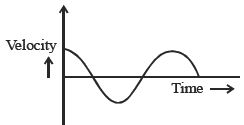
- 9View SolutionThe graph in figure represents
- 10View SolutionA point particle of mass $0.1\, kg$ is executing $S.H.M$. of amplitude of $0.1\, m$. When the particle passes through the mean position, its kinetic energy is $8\times10^{-3}$ Joule. Obtain the equation of motion of this particle if this initial phase of oscillation is $45^o$.