MCQ
The following statement is false for Helmholtz coils
  • A
    in Helmholtz coils, both coils are coaxial
  • planes of Helmholtz coils are perpendicular to each other.
  • C
    The distance between coils is equal to the radius of either coil.
  • D
    The magnetic field produced at the central part between the coils is uniform.
Answer

Correct option: B.
planes of Helmholtz coils are perpendicular to each other.
b
The magnetic field lines can cross each other.If the magnetic field lines cross each other, it would mean that magnetic field has two directions at that point, which is not possible. Hence, magnetic field lines can cross each other.

Need a full question paper?

Generate a complete, print-ready paper with questions like this in minutes — across 16+ boards, with answer keys.

Start Generating Free

Similar questions

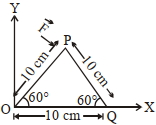
A triangular plate is shown. A force $\overrightarrow{ F }=4 \hat{ i }-3 \hat{ j }$ is applied at point $P$. The torque at point $P$ with respect to point $'O'$ and $'Q'$ are
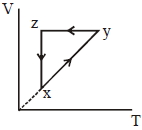
A thermodynamic cycle $xyzx$ is shown on a $V-T$ diagram.

The $P-V$ diagram that best describes this cycle is

(Diagrams are schematic and not to scale)

A galvanometer has a coil of resistance $100\, ohm$ and gives a full scale deflection for $30\, mA$ current. If it is to work as a voltmeter of $30\, volt$ range, the resistance required to be added will be.....$Ω$
If an electric current is passed through a nerve of a man, then man
A coin is placed on a disc. The coefficient of friction between the coin and the disc is $\mu$. If the distance of the coin from the center of the disc is $r$, the maximum angular velocity which can be given to the disc, so that the coin does not slip away, is:
A nucleus of mass $M$ at rest splits into two parts having masses $\frac{M^{\prime}}{3}$ and $\frac{2 M^{\prime}}{3}\left(M^{\prime} < M\right)$. The ratio of de Broglie wavelength of two parts will be.
The magnetic moment $(\mu )$ of a revolving electron around the nucleus varies with principal quantum number $n$ as
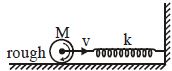
A solid sphere rolls without slipping and presses a spring of spring constant $k$ as shown in figure. Then, the maximum compression in the spring will be
Assertion : Bohr had to postulate that the electrons in stationary orbits around the nucleus do not radiate.
Reason : According to classical physics all moving electrons radiate
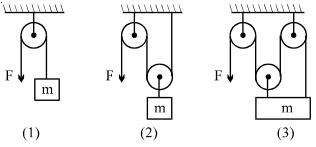
Equal force $F ( > mg)$ is applied to string in all the $3$ cases. Starting from rest, the point of application of force moves a distance of $2 m$ down in all cases. In which case the block has maximum kinetic energy?