MCQ
The following statement is false for Helmholtz coils
  • A
    in Helmholtz coils, both coils are coaxial
  • planes of Helmholtz coils are perpendicular to each other.
  • C
    The distance between coils is equal to the radius of either coil.
  • D
    The magnetic field produced at the central part between the coils is uniform.
Answer

Correct option: B.
planes of Helmholtz coils are perpendicular to each other.
b
The magnetic field lines can cross each other.If the magnetic field lines cross each other, it would mean that magnetic field has two directions at that point, which is not possible. Hence, magnetic field lines can cross each other.

Need a full question paper?

Generate a complete, print-ready paper with questions like this in minutes — across 16+ boards, with answer keys.

Start Generating Free

Similar questions

The amplification factor of a triode is $20$ and trans-conductance is $3$ milli mho and load resistance $3 \times {10^4}\Omega $, then the voltage gain is
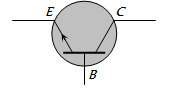
The symbol given in figure represents
The distance between an object and a screen is $100\, cm .$ A lens can produce real image of the object on the screen for two different positions between the screen and the object. The distance between these two positions is $40\, cm .$ If the power of the lens is close to $\left(\frac{ N }{100}\right) D$ where $N$ is an integer, the value of $N$ is.......
L, C and R represent the physical quantities inductance, capacitance and resistance respectively. Which of the following combinations have dimensions of frequency?
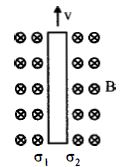
Consider a thin metallic sheet perpendicular to the plane of the paper moving with speed $'v'$ in a uniform magnetic field $B$ going into the plane of the paper (See figure). If charge densities ${\sigma _1}$ and ${\sigma _2}$ are induced on the left and right surfaces, respectively, of the sheet then (ignore fringe effects)
The curve of binding energy per nucleon as a function of atomic mass number has a sharp peak for helium nucleus. This implies that helium
A screen is placed $50\,cm$ from a single slit which is illuminated with $6000\,\mathop A\limits^o $. If distance between first and third minima in the diffraction pattern is $3\,mm.$ What is the width of the slit ?
The transformation ratio in the step-up transformer is
To remove the chromatic aberration, the combination of lenses should be such that
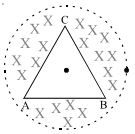
$A$ triangular wire frame (each side $= 2m$) is placed in a region of time variant magnetic field having $dB/dt = \sqrt 3 \,T/s$. The magnetic field is perpendicular to the plane of the triangle. The base of the triangle $AB$ has a resistance $1 \Omega$ while the other two sides have resistance $2\Omega$ each. The magnitude of potential difference between the points $A$ and $B$ will be....$V$