Question
The force of viscosity is:
  1. Electromagnetic.
  2. Gravitational.
  3. Nuclear.
  4. Weak.

Answer

  1. Electromagnetic.

Explanation:

The force of viscosity arises from molecular Interaction between different layers of fluids that are In motion. Molecular forces are electromagnetic in nature. Therefore, viscosity must also be electromagnetic.

Need a full question paper?

Generate a complete, print-ready paper with questions like this in minutes — across 16+ boards, with answer keys.

Start Generating Free

Similar questions

In the diagram, three point charges (labeled 1, 2 and 3) are shown, along with the electric field around them. Which charge(s) is/ are positive?
Mark the correct options:
  1. An atom with a vacancy has smaller energy that a neutral atom.
  2. K X-ray is emitted when a hole makes a jump from the K shell to some other shell.
  3. The wavelength of K X-ray is smaller than the wavelength of L X-ray of the same material.
  4. The wavelength of $\text{K}_\alpha$ X-ray is smaller than the wavelength of $\text{K}_\beta$ X-ray of the same material.
Two waves of equal amplitude A, and equal frequency travel in the same direction in a medium. The amplitude of the resultant wave is:
  1. 0
  2. A
  3. 2A
  4. Between 0 and 2A
A dip circle is so set that its needle moves freely in the magnetic meridian. In this position, the angle of dip is 40º. Now the dip circle is rotated so that the plane in which the needle moves makes an angle of 30º with the magnetic meridian. In this position, the needle will dip by an angle:
A coil has 100 turns. When a current of 5A produces a magnetic flux of $1\mu\text{Wb}$, the coefficient of self induction is :

Three electric bulbs of rating 60W each are joined in series and then connected to electric mains. The power consumed by these three bulbs will be

(a) 180 W

(b) 60 W

(c) 20 W  

(d)  

The graph which represents the correct variation of logarithm of activity (log A) versus time, in figure is
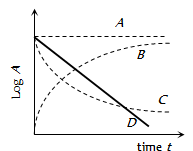
(a) A

(b) B

(c) C

(d) D

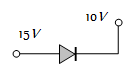
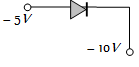
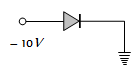
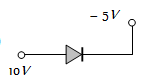
Which one is reverse-biased

(a)

(b)

(c)

(d)

A convex lens is made up of three different materials as shown in the figure.  For a point object placed on its axis, the number of images formed are
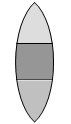
(a) 1

(b) 5

(c) 4

(d) 3

How much kinetic energy will be gained by an α - particle in going from a point at 70 V  to another point at 50 V

(a) 40 eV 

(b) 40 keV

(c) 40 MeV

(d) 0 eV