MCQ
The force of viscosity is:
  • Electromagnetic.
  • B
    Gravitational.
  • C
    Nuclear.
  • D
    Weak.

Answer

Correct option: A.
Electromagnetic.
Explanation:
The force of viscosity arises from molecular Interaction between different layers of fluids that are In motion. Molecular forces are electromagnetic in nature. Therefore, viscosity must also be electromagnetic.

Need a full question paper?

Generate a complete, print-ready paper with questions like this in minutes — across 16+ boards, with answer keys.
Start Generating Free

Similar questions

What will be the focal length of a convex lens whose power is +2.5 D ?
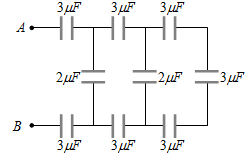
The resultant capacitance between A and B in the following figure is equal to
A solenoid has an inductance of 60 henrys and a resistance of 30 ohms. If it is connected to a 100 volt battery, how long will it take for the current to reach $\frac{e-1}{e} \approx 63.2 \%$ of its final value
Two very thin metallic wires placed along X and Y-axis carry equal currents as shown here. AB and CD are lines at 45° with the axes with origin of axes at O. The magnetic field will be zero on the line
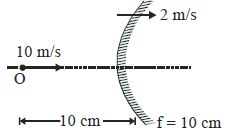
Find the velocity of image in situation as shown in figure.......$m/s$
In Young's double slit experiment the two slits are $0.6 \; mm$ distance apart. Interference pattern is observed on a screen at a distance $80 \; cm$ from the slits. The first dark fringe is observed on the screen directly opposite to one of the slits. The wavelength of light will be $\dots \; nm .$
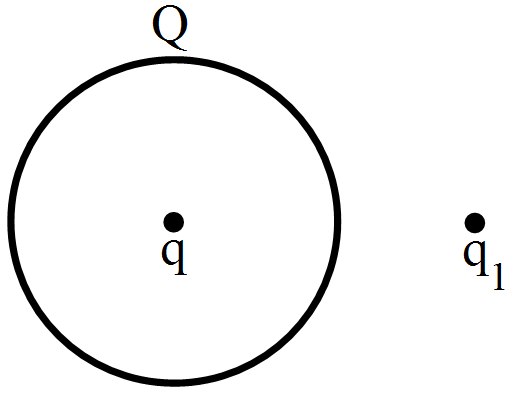
A thin, metallic spherical shell contains a charge $Q$ on it. A point charge q is placed at the centre of the shell and another charge $q_1$ is placed outside it as shown in figure. All the three charges are positive. The force on the charge at the centre is: 
A charged particle of charge $Q $ is held fixed and another charged particle of mass $m$ and charge $q$ (of the same sign) is released from a distance $r.$ The impulse of the force exerted by the external agent on the fixed charge by the time distance between $Q$ and $q$ becomes $2r$ is
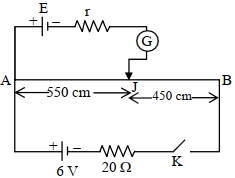
In the given figure, there is a circuit of potentiometer of length $A B=10 \,{m}$. The resistance per unit length is $0.1 \,\Omega$ per ${cm}$. Across ${AB}$, a battery of emf ${E}$ and internal resistance ' ${r}^{\prime}$ is connected. The maximum value of emf measured by this potentiometer is : (In $V$)
Which of the following is non-ohmic resistance?