MCQ
The formula for electrostatic potential is _____________.
- AElectrostatic potential = Work done × charge
- BElectrostatic potential = Work done/ charge
- CElectrostatic potential = Work done + charge
- DElectrostatic potential = Work done - charge
Explanation:
The formula for electrostatic potential is Electrostatic potential = Work done/ charge.
Generate a complete, print-ready paper with questions like this in minutes — across 16+ boards, with answer keys.
Which arrangement of four identical resistances should be used to draw maximum energy from a cell of voltage V
|
(a)
|
(b)
|
|
(c)
|
(d)
|
Assertion : The resistivity of a semiconductor increases with temperature.
Reason : The atoms of a semiconductor vibrate with larger amplitude at higher temperature there by increasing it's resistivity.
|
(a) If both assertion and reason are true and the reason is the correct explanation of the assertion. |
|
(b) If both assertion and reason are true but reason is not the correct explanation of the assertion. |
|
(c) If assertion is true but reason is false. |
|
(d) If the assertion and reason both are false. |
Water boils in an electric kettle in 15 minutes after switching on. If the length of the heating wire is decreased to 2/3 of its initial value, then the same amount of water will boil with the same supply voltage in
|
(a) 15 minutes |
(b) 12 minutes |
(c) 10 minutes |
(d) 8 minutes |
When  undergoes fission, 0.1% of its original mass is changed into energy. How much energy is released if 1kg of
  undergoes fission
|
(a) 9 |
(b) 9 |
(c) 9 |
(d) 9 |
The magnetic needle of a tangent galvanometer is deflected at an angle 30o due to a magnet. The horizontal component of earth’s magnetic field 0.34 × 10⁻⁴ T is along the plane of the coil. The magnetic intensity is
|
(a) 1.96 × 10⁻⁴ T |
(b) 1.96 × 10⁻⁵ T |
(c) 1.96 × 10⁴ T |
(d) 1.96 × 10⁵ T |
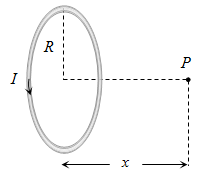
A coil having N turns carry a current I as shown in the figure. The magnetic field intensity at point P is
|
(a) |
(b) |
(c) |
(d) Zero |


