MCQ
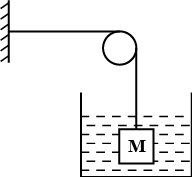
The frequency of a sonometer wire is $f$, but when the weights producing the tensions are completely immersed in water the frequency becomes $f/2$ and on immersing the weights in a certain liquid the frequency becomes $f/3$. The specific gravity of the liquid is: 
  • A
    $\frac{4}{3}$
  • B
    $\frac{16}{9}$
  • C
    $\frac{15}{12}$
  • $\frac{32}{27}$

Answer

Correct option: D.
$\frac{32}{27}$
d
Frequency of the sonometer when the mass is immersed in water is

$f_{w}=\frac{1}{2 l} \sqrt{\frac{M g-V \rho_{w} g}{m}}$

Here $V \rho g$ is the buoyancy force.

$f_{w}=\frac{f}{2} \Rightarrow \frac{1}{4 l} \sqrt{\frac{M g}{m}}=\frac{1}{2 l} \sqrt{\frac{M g-V \rho_{w g}}{m}}$

Here $\rho_{w}=1$

Squaring both sides of the above equation, we get

$\frac{M}{4}=M-V \Rightarrow V=M-M / 4=\frac{3 M}{4}........(1)$

Frequency of the sonometer when the mass is immersed in the unknown liquid is

$f_{L}=\frac{1}{2 l} \sqrt{\frac{M g-V \rho_{L} g}{m}} \Rightarrow \frac{1}{6 l} \sqrt{\frac{M g}{m}}=\frac{1}{2 l} \sqrt{\frac{M g-V \rho_{L} g}{m}}$

Using the value of $V$ from equation $(1),$ we get

$\Rightarrow \frac{M}{9}=M-V \rho_{L} \Rightarrow \frac{M}{9}=M-\frac{3 M}{4} \rho_{L}$

$\Rightarrow \rho_{L}=\frac{32}{27}$
Need a full question paper?

Generate a complete, print-ready paper with questions like this in minutes — across 16+ boards, with answer keys.

Start Generating Free

Similar questions

A gas mixture consists of $8$ moles of argon and $6$ moles of oxygen at temperature $T$. Neglecting all vibrational modes, the total internal energy of the system is
At a certain temperature for given wave length, the ratio of emissive power of a body to emissive power of black body in same circumstances is known as
A mosquito is moving with a velocity $\overrightarrow{ v }=0.5 t ^{2} \hat{ i }+3 t \hat{ j }+9 \hat{ k }\, m / s$ and accelerating in uniform conditions. What will be the direction of mosquito after $2 \,s$ ?
What is the value of linear velocity if $\overrightarrow r  = 3\widehat i + 4\widehat j + 6\widehat k$ and $\overrightarrow \omega   = -5\widehat i + 3\widehat j + 5\widehat k$ ?
A string under a tension of $129.6\,\, N$ produces $10\,\, beats /sec$  when it is vibrated along with a tuning fork. When the tension is the string is increased to $160\,\, N,$ it sounds in unison with same tuning fork. calculate fundamental freq. of tuning fork .... $Hz$
To a person, going eastward in a car with a velocity of $25\, km/hr$, a train appears to move towards north with a velocity of $25\sqrt 3 $ $km/hr$. The actual velocity of the train will be..........$km/hr$
Particle $A$ is moving along $x$-axis. At time $t=0$, it has velocity of $10\,m / s$ and acceleration $-4\,m / s ^2$. Particle $B$ has velocity of $20\,m / s$ and acceleration $-2\,m / s ^2$. Initially, both the particles are at origin. At time $t=2\,s$, distance between the two particles is $.............\,m$
A string is rigidly tied at two ends and its equation of vibration is given by $y = \cos 2\pi \,t\sin \sin \pi x.$ Then minimum length of string is .... $m$
Why the spring is made up of steel in comparison of copper
An insect crawls up a hemispherical surface very slowly. The coefficient of friction between the insect and the surface is $1/3$. If the line joining the centre of the hemispherical surface to the insect makes an angle $\alpha $ with the vertical, the maximum possible value of $\alpha $ so that the insect does not slip is given by