MCQ
The frequency of tuning forks $A$ and $B$ are respectively $3\%$ more and $2\%$ less than the frequency of tuning fork $C.$ When $A$ and $B$ are simultaneously excited, $5$ beats per second are produced. Then the frequency of the tuning fork $'A'$ (in $Hz$) is
  • A
    $98$
  • B
    $100$
  • $103$
  • D
    $105$

Answer

Correct option: C.
$103$
c
(c) Let $n$ be the frequency of fork $C$

then ${n_A} = n + \frac{{3n}}{{100}} = \frac{{103n}}{{100}}$ 

and ${n_B} = n - \frac{{2n}}{{100}} = \frac{{98}}{{100}}$

but ${n_A} - {n_B} = 5$

==> $\frac{{5n}}{{100}} = 5$

==> $n = 100\,Hz$ 

$ \therefore$ ${n_A} = \frac{{(103)(100)}}{{100}} = 103\,Hz$

Need a full question paper?

Generate a complete, print-ready paper with questions like this in minutes — across 16+ boards, with answer keys.

Start Generating Free

Similar questions

Given below are two statements : one is labelled as Assertion A and the other is labelled as Reason $R$. Assertion A : Efficiency of a reversible heat engine will be highest at $-273^{\circ} C$ temperature of cold reservoir.

Reason $R$ : The efficiency of Carnot's engine depends not only on temperature of cold reservoir but it depends on the temperature of hot reservoir too and is given as $\eta=\left(1-\frac{ T _2}{ T _1}\right)$.

In the light of the above statements, choose the correct answer from the options given below

The molar specific heat of a gas as given from the kinetic theory is $\frac{5}{2} R$. If it is not specified whether it is $C _{ P }$ or $C _{ V }$, one could conclude that the molecules of the gas
Young's modulus is determined by the equation given by $\mathrm{Y}=49000 \frac{\mathrm{m}}{\ell} \frac{\text { dyne }}{\mathrm{cm}^2}$ where $\mathrm{M}$ is the mass and $\ell$ is the extension of wre used in the experiment. Now error in Young modules $(\mathrm{Y})$ is estimated by taking data from $M-\ell$ plot in graph paper. The smallest scale divisions are $5 \mathrm{~g}$ and $0.02$ $\mathrm{cm}$ along load axis and extension axis respectively. If the value of $M$ and $\ell$ are $500 \mathrm{~g}$ and $2 \mathrm{~cm}$ respectively then percentage error of $\mathrm{Y}$ is :
Two projectiles are projected at $30^{\circ}$ and $60^{\circ}$ with the horizontal with the same speed. The ratio of the maximum height attained by the two projectiles respectively is:
A particle of mass $m$ projected with a velocity ' $u$ ' making an angle of $30^{\circ}$ with the horizontal. The magnitude of angular momentum of the projectile about the point of projection when the particle is at its maximum height $\mathrm{h}$ is :
If a piece of ice at $0^{\circ} $ temperature is put into water at $0^{\circ}\text C $temperature, then in ideal condition the ice :
Two identical satellites $A$ and $B$ are circulating round the earth at the height of $R$ and $2R$ respectively, (where $R$ is radius of the earth). The ratio of kinetic energy of $A$ to that of $B$ is
$N$ molecules each of mass $m$ of gas $A$ and $2N$ molecules each of mass $2m$ of gas $B$ are contained in the same vessel at temperature $T.$ The mean square of the velocity of molecules of gas $B$ is ${v^2}$ and the mean square of $x$ component of the velocity of molecules of gas $A$ is ${w^2}$. The ratio $\frac{{{w^2}}}{{{v^2}}}$ is
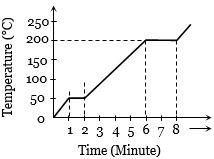
A student takes $50\,gm$ wax $($specific heat $= 0.6\, kcal/kg°C)$ and heats it till it boils. The graph between temperature and time is as follows. Heat supplied to the wax per minute and boiling point are respectively
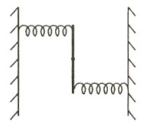
A uniform rod of length $L$ and mass $M$ is pivoted at the centre. Its two ends are attached to two springs of equal spring constants $k$. The springs are fixed to rigid supports as shown in the figure, and the rod is free to oscillate in the horizontal plane. The rod is gently pushed through a small angle $\theta$ in one direction and released. The frequency of oscillation is