MCQ
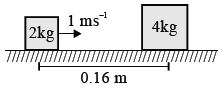
The friction coefficient between the horizontal surface and each of the block shown in  figure is $0.2.$ The collision between the blocks is perfectly elastic. What is the  separation between the blocks when they come to rest :- .............. $\mathrm{cm}$
  • $5 $
  • B
    $10 $
  • C
    $16$
  • D
    $20$

Answer

Correct option: A.
$5 $
a
Retardation of $2 \mathrm{kg}$ block, $\mathrm{a}=\mu \mathrm{g}, 2 \mathrm{m} / \mathrm{s}^{2}$

velocity of $2 \mathrm{kg}$ block before collision,

$\mathrm{u}_{1}=\sqrt{(1)^{2}-2(2)(0.16)}=0.6 \mathrm{m} / \mathrm{s}$

now $2(0.6)=2 v_{1}+4 v_{2}$ and $v_{2}-v_{1}=0.6$

$\therefore \quad \mathrm{v}_{1}=-0.2 \mathrm{m} / \mathrm{s} \quad$ and $\mathrm{v}_{2}=0.4 \mathrm{m} / \mathrm{s}$

$S_{1}=\frac{(0.2)^{2}}{2 \times 2}=0.01$

$S_{2}=\frac{(0.4)^{2}}{2 \times 2}=0.04$

$\mathrm{S}=\mathrm{S}_{1}+\mathrm{S}_{2}=0.05=5 \mathrm{cm}$

Need a full question paper?

Generate a complete, print-ready paper with questions like this in minutes — across 16+ boards, with answer keys.

Start Generating Free

Similar questions

Three liquids of densities $\rho _1,\rho _2$ and $\rho _3$ (with $\rho _1 > \rho _2 > \rho_3),$ having the same value of surface tension $T,$ rise to the same height in three identical capillaries. The angles of contact $\theta_1 \,,\theta_2$ and $\theta_3$ obey  
A circular hole of diameter $R$ is cut from a disc of mass $M$ and radius $R ;$ the circumference of the cut passes through the centre of the disc . The moment of inertia of the remaining portion of the disc about an axis perpendicular to the disc and passing through its centre is
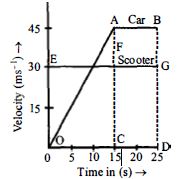
The velocity-time graphs of a car and a scooter are shown in the figure. $(i)$ the difference between the distance travelled by the car and the scooter in $15\, s$ and $(ii)$ the time at which the car will catch up with the scooter are, respectively
An object may have:
A particle moves along a circle with a constant angular speed $\omega$ Its displacement,with respect to this position of the particle at time $t = 0$ is plotted against time. The graph would look like
A force of $- P \hat{k}$ acts on the origin of the coordinate system. The torque about the point $(2,-3)$ is $P(a \hat{i}+b \hat{j})$, the ratio of $\frac{a}{b}$ is $\frac{x}{2}$. The value of $x$ is
A mass of $50\, {kg}$ is placed at the centre of a uniform spherical shell of mass $100\, {kg}$ and radius $50 \,{m}$. If the gravitational potential at a point, $25\, {m}$ from the centre is ${V} \,{kg} / {m} .$ The value of ${V}$ is
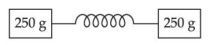
As per the given figure, two blocks each of mass $250\,g$ are connected to a spring of spring constant $2\,Nm ^{-1}$. If both are given velocity $V$ in opposite directions, then maximum elongation of the spring is:
Three point masses ${m_1},\,{m_2},\,{m_3}$ are located at the vertices of an equilateral triangle of length $'a'$. The moment of inertia of the system about an axis along the altitude of the triangle passing through ${m_1}$ is 
To what temperature should the hydrogen at $327°C$ be cooled at constant pressure, so that the root mean square velocity of its molecules become half of its previous value ....... $^oC$