MCQ
The fringe width in Young’s double slit experiment increases when
  • Wavelength increases
  • B
    Distance between the slits increases
  • C
    Distance between the source and screen decreases
  • D
    The width of the slits increases

Answer

Correct option: A.
Wavelength increases

Need a full question paper?

Generate a complete, print-ready paper with questions like this in minutes — across 16+ boards, with answer keys.
Start Generating Free

Similar questions

A conducting circular loop of radius r carries a constant current i. It is placed in a uniform magnetic field $\vec B$, such that $\vec B$ is perpendicular to the plane of the loop. The magnetic force acting on the loop is
In a Young's double slit experiment with light of wavelength $\lambda ,$ fringe pattern on the screen has fringe width $\beta .$ When two thin transparent glass (refractive index $\mu$ ) plates of thickness $t_1$ and $t_2\,\,(t_1 > t_2)$ are placed in the path of the two beams respectively, the fringe pattern will shift by a distance
A small square loop of wire of side $l$ is placed inside a large square loop of wire of side $L(L >> l)$. The loops are coplaner and their centres coincide. The mutual inductance of the system is propotional to
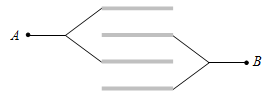
Four plates of the same area of cross-section are joined as shown in the figure. The distance between each plate is d. The equivalent capacity across A and B will be
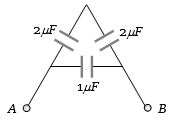
What is the effective capacitance between $A$ and $B$ in the following figure........$\mu \,F$
If a white light is used in Young’s double slit experiments then a very large number of coloured fringes can be seen
Check the incorrect statement: When a magnet is moved into a coil the strength of the current depends on:
Hydrogen atoms are excited from ground state of the principal quantum number 4. Then the number of spectral lines observed will be
Displacement current is set up between the plates of a capacitor when the potential difference across the plates is ..............
A proton is about $1840$ times heavier than an electron. When it is accelerated by a potential difference of $1\, kV$, its kinetic energy will be......$keV$