MCQ
The function $f: A \rightarrow B$ defined by $f(x)=-x^2+6 x-8$ is a bijection if,
  • $\text{A}=(-\infty,3]$ and $\text{B}=(-\infty,1]$
  • B
    $\text{A}=[-3,\infty)$ and $\text{B}=(-\infty,1]$
  • C
    $\text{A}=(-\infty,3]$ and $\text{B}=[1,\infty)$
  • D
    $\text{A}=[3,\infty)$ and $\text{B}=[1,\infty)$
Answer

Correct option: A.
$\text{A}=(-\infty,3]$ and $\text{B}=(-\infty,1]$
$f(x) = -x^2 + 6x - 8$, is a polynomial function and the domain of polynomial function is real number.
$\therefore\ \text{x}\in\text{R}$
$f(x) = -x^2 + 6x - 8$
$= -(x^2 - 6x + 8)$
$= -(x^2 - 6x + 9 - 1)$
$= -(x - 3)^2 + 1$
Maximum value of $-(x - 3)^2$ woud be $0$
$\therefore$ Maximum value of $-(x - 3)^2 + 1$ woud be $1$
$\therefore\ \text{f(x)}\in(-\infty,1]$

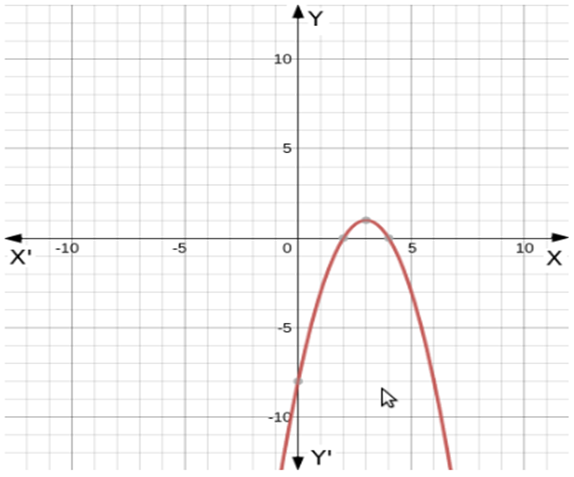
We can see from the given graph that function is symmetrical about $x = 3$ and the given function is bijective.
So$, x$ would be either $(-\infty,3]$ or $[3,\infty)$
The correct option which satisfy $A$ and $B$ both is:
$\text{A}=(-\infty,3]$ and $\text{B}=(-\infty,1]$

Need a full question paper?

Generate a complete, print-ready paper with questions like this in minutes — across 16+ boards, with answer keys.

Start Generating Free

Similar questions

If $AA^T = I$ and $C$ is skew symmetric matric then $((A^T CA)^{50})^T$ is equal to
Apply linear programming to this problem. A firm wants to determine how many units of each of two products (products D and E) they should produce to make the most money. The profit in the manufacture of a unit of product D is 100 and the profit in the manufacture of a unit of product E is100 and the profit in the manufacture of aunit of product E is 87. The firm is limited by its total available labor hours and total available machine hours. The total labor hours per week are 4,000. Product D takes 5 hours per unit of labor and product E takes 7 hours per unit. The total machine hours are 5,000 per week. Product D takes 9 hours per unit of machine time and product E takes 3 hours per unit. Which of the following is one of the constraints for this linear program?
A fair die is thrown twenty times. The probability that on the tenth throw the fourth six appears is:
If $a, b, c$  are mutually perpendicular vectors of equal magnitudes, then the angle between the vectors $a$ and $a + b + c$ is
Consider the matrix $f(x)=\left[\begin{array}{ccc}\cos x & -\sin x & 0 \\ \sin x & \cos x & 0 \\ 0 & 0 & 1\end{array}\right]$

Given below are two statements:

Statement I: $f(-x)$ is the inverse of the matrix $f(x)$.

Statement II: $f(x) f(y)=f(x+y)$.

In the light of the above statements, choose the correct answer from the options given below

Choose the correct answer from the given four options.

The feasible solution for a LPP shown in Fig. 12.12. Let z = 3x - 4y be objective functio. (Maximum value of Z + Minimum value of Z) is equal to:
For $n \in N$, if $\cot ^{-1} 3+\cot ^{-1} 4+\cot ^{-1} 5+\cot ^1 n=\frac{\pi}{4}$, then $\mathrm{n}$ is equal to .........
Let $\text{f(x)}=\text{x}+\text{b}|\text{x}|+\text{c}|\text{x}|^4,$ where a, b, and c are real constants. Then, f (x) is differentiable at x = 0, if:
The radius of a circular plate is increasing at the rate of 0.01cm/sec. The rate of increase of its area when the radius is 12cm, is:
If $\text{A} =\displaystyle \begin{bmatrix} -1 &\text{amp; } 0 &\text{amp; }0 \\ 0 &\text{amp; }\text{x} &\text{amp; } 0 \\ 0 &\text{amp; } 0 &\text{amp; }\text{m} \end{bmatrix}$is a scalar matrix then $\text{x}+\text{m}=$