Question
The function $f(x) = 2x^3 - 3x^2 - 12x + 4,$ has:

Answer

We have, $f(x) = 2x^3 - 3x^2 - 12x + 4$
$\Rightarrow f'(x) = 6x^2 - 6x - 12$
$\Rightarrow f'(x) = 6(x^2 - x - 2)$
$\Rightarrow f'(x) = 6(x + 1)(x - 2)$
Find the critical points by equating $f'(x)$ to $0.$
$\therefore f'(x) = 0$
$\Rightarrow 6(x + 1)(x - 2) = 0$
$\Rightarrow x = -1$ and $x = +2$​​​​​​​

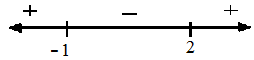
From the above number line, we can conclude that, $x = -1$ is point of local maxima and $x = 2$ is point of local minima.
Thus, $f(x)$ has one maxima and one minima.

Need a full question paper?

Generate a complete, print-ready paper with questions like this in minutes — across 16+ boards, with answer keys.

Start Generating Free

Similar questions

Let $A = \{1, 2, 3, …. n\}$ and $B = \{a, b\}.$ Then the number of surjections from $A$ into $B$ is$:$
In order to maximize the profit of the company, the optimal solution of which of the following equations is required?
Choose the correct answer from given four options in each of the Exercise:
There are two values of a which makes determinant $\begin{bmatrix}1 & -2 & 5 \\2 & \text{a} & 1\\0 & 4 & 2\text{a} \end{bmatrix} = 86,$ then sum of these number is:
$\int\frac{1}{1+\tan\text{x}}\text{ dx}=$
  1. $\log_\text{e}(\text{x}+\sin\text{x})+\text{C}$
  2. $\log_\text{e}(\sin\text{x}+\cos\text{x})+\text{C}$
  3. $2\sec^2\frac{\text{x}}{2}+\text{C}$
  4. $\frac{1}{2}\big[\text{x}+\log(\sin\text{x}+\cos\text{x})\big]+\text{C}$
If A is a square matrix, then AA is a:
  1. Skew-symmetric matrix.
  2. Symmetric matrix.
  3. Diagonal matrix.
  4. None of these.
If $\frac{\text{dy}}{\text{dx}}=\frac{1}{\text{x}}$ then y =
  1. $\text{ln }\text{x}+\text{c}$
  2. $\text{x}+\text{c}$
  3. $\frac{-1}{\text{x}^2}+\text{c}$
  4. $\frac{1}{\text{x}^2}+\text{c}$
The matrix $\begin{bmatrix} 5 & 10 & 3 \\ -2 & -4 & 6 \\ -1 & -2 & \text{b} \end{bmatrix}$ is a singular matrix, if the value of b is:
  1. -3
  2. 3
  3. 0
  4. Now-existent
The area bounded by $y = 2 - x^2$ and $x + y = 0$ is:
The differential equation  $\frac{\text{d}^2\text{y}}{\text{dx}^2}+\frac{\text{dy}}{\text{dx}}+\text{y}+\text{x}^2=0$ of the following type:
  1. linear
  2. homogeneous
  3. order two
  4. degree one
If the function $f(x) = x^3 - 9kx^2 + 27x + 30$ is increasing on $R,$ then: