Questions

M.C.Q (1 Marks)

🎯

Test yourself on this topic

24 questions · timed · auto-graded

Question 11 Mark
The slope of tangent to the curve $x = t^2 + 3t - 8, y = 2t^2 - 2t - 5$ at the point $(2, -1)$ is:
Answer
Given equation of curve is
$\text{x}=\text{t}^2+3\text{t}-8$ and $\text{y}=2\text{t}^2-2\text{t}-5$
$\therefore\ \frac{\text{dx}}{\text{dy}}=2\text{t}+3$ and $\frac{\text{dy}}{\text{dx}}=4\text{t}-2$
$\Rightarrow\ \frac{\text{dy}}{\text{dx}}=\frac{\frac{\text{dy}}{\text{dt}}}{\frac{\text{dx}}{\text{dt}}}=\frac{4\text{t-2}}{2\text{t}+3}\ \ \dots(\text{i})$
Since, the curve passes through the point $(2, -1),$ we have
$2 = t^2 + 3t - 8$
and $-1 = 2t^2 - 2t - 5$
$\Rightarrow t^2 + 3t - 10 = 0$
And $2t^2 - 2r - 4 = 0$
$\Rightarrow t^2 + 5t - 2t - 10 = 0$
And $2t^2 + 2t - 4t - 4 = 0$
$\Rightarrow t(t + 5) - 2(t + 5) = 0$
And $2t(t + 1) - 4(t + 1) = 0$
$\Rightarrow (t - 2)(t + 5) = 0$
And $(2t - 4)(t + 1) = 0$
$\Rightarrow t = 2, -5$ and $t = 1, 2$
$\Rightarrow t = 2 ($common value$)$
From equation $(i),$
$\therefore$ Slope of tangent, $\Big(\frac{\text{dy}}{\text{dx}}\Big)_{\text{t}=2}=\frac{4\times2=2}{2\times2+3}=\frac{6}{7}$ 
View full question & answer
Question 21 Mark
he two curves $x^3 - 3xy^2 + 2 = 0$ and $3x^2y - y^3 - 2 = 0$ intersect at an angle of:
Answer

We have, $x^3 - 3xy^2 + 2 = 0$ and $3x^2y - y^3 - 2 = 0$
$\Rightarrow\ 3\text{x}^2-3\Big[\text{x}\cdot2\text{y}\frac{\text{dy}}{\text{dx}}+\text{y}^2\cdot1\Big]+0=0$ and $3\Big[\text{x}^2\frac{\text{dy}}{\text{dx}}+\text{y}\cdot2\text{x}\Big]-3\text{y}^2\frac{\text{dy}}{\text{dx}}-0=0$
$\Rightarrow\ 6\text{xy}\frac{\text{dy}}{\text{dx}}+3\text{y}^2=3\text{x}^2$ and $3\text{y}^2\frac{\text{dy}}{\text{dx}}=3\text{x}^2\frac{\text{dy}}{\text{dx}}+6\text{xy}$
$\Rightarrow\ \frac{\text{dy}}{\text{dx}}=\frac{3\text{x}^2-3\text{y}^2}{6\text{xy}}$ and $\frac{\text{dy}}{\text{dx}}=\frac{6\text{xy}}{3\text{y}^2-3\text{x}^2}$
$\Rightarrow\ \Big(\frac{\text{dy}}{\text{dx}}\Big)=\frac{3(\text{x}^2-\text{y}^2)}{6\text{xy}}$ and $\Big(\frac{\text{dy}}{\text{dx}}\Big)=\frac{-6\text{xy}}{3(\text{x}^2-\text{y}^2)}$
$\Rightarrow\ \text{m}_1=\frac{\text{x}^2-\text{y}^2}{2\text{xy}}$ and $\text{m}_2=\frac{-2\text{xy}}{\text{x}^2-\text{y}^2}$
$\therefore\ \text{m}_1\text{m}_2=\frac{\text{x}^2-\text{y}^2}{2\text{xy}}\cdot\frac{-(2\text{xy})}{\text{x}^2-\text{y}^2}=-1$
Since, the product of the slopes is $-1.$
Hence, both the curves are intersecting at right angle i.e., making $\frac{\pi}{2}$ with each other.

View full question & answer
Question 31 Mark
Maximum slope of the curve $y = -x^3 + 3x^2 + 9x - 27$ is:
Answer
We have, $y = -x^3 + 3x^2 + 9x - 27$
$\therefore\ \frac{\text{dy}}{\text{dx}}=-3\text{x}^2+6\text{x}+9=$ Slope of the curve
And $\frac{\text{d}^2\text{y}}{\text{dx}^2}=-6\text{x}+6=-(\text{x}-1)$
$\frac{\text{d}^2\text{y}}{\text{dx}^2}=0$
$\Rightarrow-6(\text{x}-1)=0$
$\Rightarrow\text{x}=1$
Now,$\frac{\text{d}^3\text{y}}{\text{dx}^3}=-6<0$
So, the slope is maximum when $x = 1$
$\therefore\ \Big(\frac{\text{dy}}{\text{dx}}\Big)_{(\text{x}=1)}=-3.1^2+6.1+9=12$
View full question & answer
Question 41 Mark
The interval on which the function $f(x) = 2x^3 + 9x^2 + 12x - 1$ is decreasing is:
Answer

We have, $f(x) = 2x^3 + 9x^2 + 12x - 1$
$\therefore f'(x) = 6x^2 + 18x + 12$
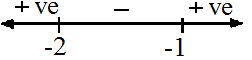
$= 6(x^2 + 3x + 2) = 6(x + 2)(x + 1)$
So, $\text{f}'(\text{x})\leq0,$ for decreasing.
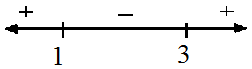
On drawing number lines as below.

We see that $f'(x)$ is decreasing in $[-2, -1].$

View full question & answer
Question 51 Mark
The equation of normal to the curve $3x^2 - y^2 = 8$ which is parallel to the line $x + 3y = 8$ is:
Answer

we have, the equation of the curve is $3x^2 - y^2 = 8 ...(i)$
Also, the given equation of the line is $x + 3y = 8$
$\Rightarrow\ 3\text{y}=8-\text{x}$
$\Rightarrow\ \text{y}=-\frac{\text{x}}{3}+\frac{8}{3}$
Thus, slope of the line is $-\frac{1}{3}$ which should be equal to slope of the equation of normal to the curve.
On differentiating Eq. $(i)$ w.r.t. x, we get
$6\text{x}-2\text{y}\frac{\text{dy}}{\text{dx}}=0$
$\Rightarrow\ \frac{\text{dy}}{\text{dx}}=\frac{6\text{x}}{2\text{y}}=\frac{3\text{x}}{\text{y}}=$ Slope of the curve
Now, slope of normal to the curve $=-\frac{1}{\Big(\frac{\text{dy}}{\text{dx}}\Big)}$
$=-\frac{1}{\Big(\frac{3\text{x}}{\text{y}}\Big)}=-\frac{\text{y}}{3\text{x}}$
$\therefore\ -\Big(\frac{\text{y}}{3\text{x}}\Big)=-\frac{1}{3}$
$\Rightarrow\ 3\text{y}=-3\text{x}$
$\Rightarrow\ \text{y}=\text{x}$
On substituting the value of the given equation of the curve, we get
$3\text{x}^2-\text{x}^2=8$
$\Rightarrow\ \text{x}^2=\frac{8}{2}$
$\Rightarrow\ \text{x}=\pm2$
For $\text{x}=2,3(2)^2-\text{y}^2=8$
$\Rightarrow\ \text{y}^2=4$
$\Rightarrow\ \text{y}=\pm2$
and for $\text{x}=-2,3(-2)^2-\text{y}^2=8$
$\Rightarrow\ \text{y}=\pm2$
So, the points at which normal are parallel to the given line are $(\pm2,\pm2).$
Hence, the equation of normal at $(\pm2,\pm2)$ is
$\text{y}-(\pm2)=-\frac{1}{3}[\text{x}-(\pm2)]$
$\Rightarrow\ 3[\text{y}-(\pm2)]=-[\text{x}-(\pm2)]$
$\Rightarrow\ \text{x}+3\text{y}\pm8=0$

View full question & answer
Question 61 Mark
The equation of tangent to the curve $y (1 + x^2) = 2 - x,$ where it crosses $x-$axis is:
Answer

We have, equation of the curve $y(1 + x^2) = 2 - x ...(i)$
It is given that the curve crosses $x-$axis
Putting $y = 0$ in equation $(i),$ we get
$\therefore 0(1 + x^2) = 2 - x$
$\Rightarrow x = 2$
So, the curve passes through the point $(2, 0).$
Now differentiating equation $(i)$ w.r.t. x, we get
$\therefore\ \text{y}\times(0+2\text{x})+(1+\text{x}^2)\cdot\frac{\text{dy}}{\text{dx}}=0-1$
$\Rightarrow\ \frac{\text{dy}}{\text{dx}}=\frac{-1-2\text{xy}}{1+\text{x}^2}$
$\therefore\ \Big(\frac{\text{dy}}{\text{dx}}\Big)_{(2,0)}=\frac{-1-2\times0}{1+2^2}=-\frac{1}{5}=$ slope of tangent to the curve
$\therefore$ Equation of tangent of the curve passing through $(2, 0)$ is
$\text{y}-0=-\frac{1}{5}(\text{x}-2)$
or $5\text{y}+\text{x}=2$

View full question & answer
Question 71 Mark
The tangent to the curve $y = e^{2x}$ at the point $(0, 1)$ meets $x-$axis at:
Answer
We have, $y = e^{2x}$
$\Rightarrow\ \frac{\text{dy}}{\text{dx}}=2\text{e}^{2\text{x}}$
Since, it passes through the point $(0, 1).$
$\therefore\ \Big(\frac{\text{dy}}{\text{dx}}\Big)_{(0,1)}=2\cdot\text{e}^{2\cdot0}=2=$ Slope of tangent to the curve
The equation of tangent is given by
$y - 1 = 2(x - 0)$
$\Rightarrow y - 1 = 2x$
$\Rightarrow y = 2x + 1$
We are given that, the tangent to curve $y = e^{2x}$ at the point $(0, 1)$ meets $X-$axis i.e., $y = 0.$
$\therefore\ 0=2\text{x}+1$
$\Rightarrow\ \text{x}=-\frac{1}{2}$
Thus, the required point is $\Big(\frac{-1}{2},0\Big).$
View full question & answer
Question 81 Mark
The points at which the tangents to the curve $y = x^3 - 12x + 18$ are parallel to $x-$axis are:
Answer

The given equation of curve is
$y = x^3 - 12x + 18$
$\therefore\ \frac{\text{dy}}{\text{dx}}=3\text{x}^2-12 [$on differenttiating w.r.t.$x]$
So, the slope of line parallel to the $X-$axis
$\therefore\ \Big(\frac{\text{dy}}{\text{dx}}\Big)=0$
$\Rightarrow\ 3\text{x}^2-12=0$
$\Rightarrow\ \text{x}^2=\frac{12}{3}=4$
$\therefore\ \text{x}=\pm2$
For $x = 2, y = 2^3 - 12 \times 2 + 18 = 2$
and for $x = -2, y = (-2)^3 -12(-2) + 18 = 34$
So, the points are $(2, 2)$ and $(-2, 34).$

View full question & answer
Question 91 Mark
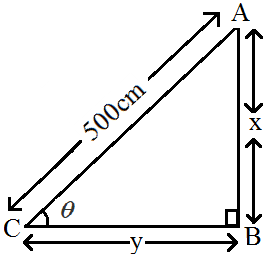
A ladder, 5 meter long, standing on a horizontal floor, leans against a vertical wall. If the top of the ladder slides downwards at the rate of 10cm/ sec, then the rate at which the angle between the floor and the ladder is decreasing when lower end of ladder is 2 metres from the wall is:
Answer
  1.  $\frac{1}{20}\text{radian/}\sec$

Solution:

Let the angle between floor and the ladder be $\theta.$

Let at any time 't' AB = x cm and BC = y cm

$\therefore\ \sin\theta=\frac{\text{x}}{500}$ and $\cos\theta=\frac{\text{y}}{500}$

$\Rightarrow\ \text{x}=500\sin\theta$ and $\text{y}=500\cos\theta$

Also it is given that $\frac{\text{dx}}{\text{dt}}=10\text{cm/s}$

$\Rightarrow\ 500\cdot\cos\theta\cdot\frac{\text{d}\theta}{\text{dt}}=10\text{cm}/ \text{s}$

$\Rightarrow\ \frac{\text{d}\theta}{\text{dt}}=\frac{10}{500\cos\theta}=\frac{1}{50\cos\theta}$

For $\text{y}=2\text{m}=20\text{cm},$

$\frac{\text{d}\theta}{\text{dt}}=\frac{1}{50\cdot\frac{\text{y}}{500}}=\frac{10}{\text{y}}$ $=\frac{10}{200}=\frac{1}{20}\text{radian/}\sec$ 

View full question & answer
Question 101 Mark
The function $\text{f(x)}=\tan\text{x}-\text{x}$
Answer
  1. Always increases.

Solution:

We have, $\text{f(x)}=\tan\text{x}-\text{x}$

$\therefore\ \text{f}'(\text{x})=\sec^2\text{x}-1$

Since, $\text{f}'(\text{x})>0,\forall\text{ x}\in\text{R}$

Hence, f(x) always increases.

View full question & answer
Question 111 Mark
If $y = x(x - 3)^2$ decreases for the values of $x$ given by:
Answer

We have, $y = x(x - 3)^2$
$\therefore\ \frac{\text{dy}}{\text{dx}} =2(x - 3).1 + (x - 3)^2.1$
$= 2x^2 - 6x + x^2 + 9 = 6x = 3x^2 - 12x + 9$
$= 3(x^2 - 3x - x + 3) = 3(x - 3)(x - 1)$​​​​​​​

So, $y = x(x - 3)^2$ decreases for $(1, 3).$
$[$since, $y' < 0$ for all $x \in (1, 3),$ hence $y$ is decreasing on $(1, 3)]$

View full question & answer
Question 121 Mark
At $\text{x}=\frac{5\pi}{6},\text{ f(x)}=2\sin3\text{x}+3\cos\text{x}$ is 6:
Answer
  1. Neither maximum nor minimum.

Solution:

We have, $\text{f(x)}=2\sin3\text{x}+3\cos3\text{x}$

$\therefore\ \text{f}'(\text{x})=2\cdot\cos3\text{x}3+3(-\sin3\text{x})\cdot3$

$\Rightarrow\ \text{f}'(\text{x})=6\cos3\text{x}-9\sin3\text{x}\ \ \dots(\text{i})$

Now, $\text{f}''(\text{x})=-18\sin3\text{x}-27\cos3\text{x}$

$=-9(2\sin3\text{x}+3\cos3\text{x})$

$\therefore\ \text{f}'\Big(\frac{5\pi}{6}\Big)=6\cos\Big(3\cdot\frac{5\pi}{6}\Big)-9\sin\Big(3\cdot\frac{5\pi}{6}\Big)$

$=6\cos\frac{5\pi}{2}-9\sin\frac{5\pi}{2}$

$=6\cos\Big(2\pi+\frac{\pi}{2}\Big)-9\sin\Big(2\pi+\frac{\pi}{2}\Big)$

$=-9\neq0$

So, $\text{x}=\frac{5\pi}{6}$ cannot be point of maxima or minima.

Hence, f(x) at $\text{x}=\frac{5\pi}{6}$ is neither maximum nor minimum.

View full question & answer
Question 131 Mark
The function $f(x) = 2x^3 - 3x^2 - 12x + 4,$ has:
Answer

We have, $f(x) = 2x^3 - 3x^2 - 12x + 4$
$\Rightarrow f'(x) = 6x^2 - 6x - 12$
$\Rightarrow f'(x) = 6(x^2 - x - 2)$
$\Rightarrow f'(x) = 6(x + 1)(x - 2)$
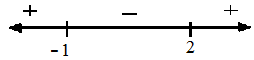
Find the critical points by equating $f'(x)$ to $0.$
$\therefore f'(x) = 0$
$\Rightarrow 6(x + 1)(x - 2) = 0$
$\Rightarrow x = -1$ and $x = +2$​​​​​​​

From the above number line, we can conclude that, $x = -1$ is point of local maxima and $x = 2$ is point of local minima.
Thus, $f(x)$ has one maxima and one minima.

View full question & answer
Question 141 Mark
The maximum value of $\Big(\frac{1}{\text{x}}\Big)^\text{x}$ is:
Answer
  1. $\text{e}^{\frac{1}{\text{e}}}$

Solution:

Let $\text{y}=\Big(\frac{1}{\text{x}}\Big)^\text{x}$

$\Rightarrow\ \log\text{y}=\text{x}\cdot\log\frac{1}{\text{x}}=-\text{x}\cdot\log\text{x}$

Diffrentiating both sides w.r.t x, we get,

$\frac{1}{\text{y}}\cdot\frac{\text{dy}}{\text{dx}}=-\text{x}\cdot\frac{1}{\text{x}}-\log\text{x}$

$=-1-\log\text{x}$

$\therefore\ \frac{\text{dy}}{\text{dx}}=-\Big(\frac{1}{\text{x}}\Big)^\text{x}(1+\log\text{x})$

Now, $\frac{\text{dy}}{\text{dx}}=0$

$\Rightarrow\ 1+\log\text{x}=0$

$\Rightarrow\ \text{x}=\frac{1}{\text{e}}$

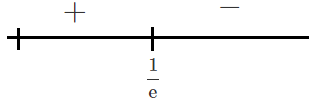
Sign scheme of f'(x) is as shown in the following figure.

From the figure, $\text{x}=\frac{1}{\text{e}}$ is the point of maxima

Hence, maximum value of y is $\Big(\frac{1}{\frac{1}{\text{e}}}\Big)^{\frac{1}{\text{e}}}=\text{e}^{\frac{1}{\text{e}}}$

View full question & answer
Question 151 Mark
The smallest value of the polynomial $x^3 - 18x^2 + 96x$ in $[0, 9]$ is:
Answer
We have, $f(x) = x^3 - 18x^2 + 96x$
$\therefore f'(x) = 3x^2 - 36x + 96$
$f'(x) = 0$
$\therefore3x^2 - 36x + 96 = 0$
$\Rightarrow 3(x^2 - 12x + 32) = 0$
$\Rightarrow (x - 8)(x - 4) = 0$
$\Rightarrow x = 4, 8$
For least value of $f(x)$ in $[0, 9],$ we should find the value of function at $x = 0,$
$4, 8, 9$
$f(0) = 0$
$f(4) = 4^3 - 18 \times 4^2 + 96 \times 4 = 64 - 288 + 384 = 160$
$f(8) = 8^3 - 18 \times 8^2 + 96 \times 8 = 128$
$f(9) = 9^3 - 18 \times 9^2 + 96 \times 9 = 729 - 1458 + 864 = 195$
Thus, absolute minimum value of f on $[0, 9]$ is $0$ occurring at $x = 0.$
View full question & answer
Question 161 Mark
Let the f: R → R be defined by $\text{f(x)}=2\text{x}+\cos\text{x}$ then f:
Answer
  1. Is an increasing function.

Solution:

We have, $\text{f(x)}=2\text{x}+\cos\text{x}$

$\Rightarrow\ \text{f}'(\text{x})=2+(-\sin\text{x})$

$=2-\sin\text{x}$

Since, the maximum value of $\sin\text{x}$ is 1.

Hence, $\text{f}'(\text{x})>0,\forall\text{ x}$

Thus, f'(x) is an increasing function.

View full question & answer
Question 171 Mark
Which of the following functions is decreasing on $\Big(0,\frac{\pi}{2}\Big)?$
Answer
  1.  $\cos\text{x}$

Solution:

$​​\text{f}_1(\text{x})=\sin2\text{x},$ increases from '0' to '1' in $\Big(0,\frac{\pi}{2}\Big)$

$\text{f}_2(\text{x})=\tan\text{x}$ is increasing function in each quadrant.

$\text{f}_3(\text{x})=\cos\text{x},$ decreases from '1' to '0' in $\Big(0,\frac{\pi}{2}\Big) $

$ \text{f}_4(\text{x})=\cos3\text{x},$ decreases if $3\text{x}\in\Big(0,\frac{\pi}{2}\Big)\ \text{or x }\in\Big(0,\frac{\pi}{6}\Big)$ 

View full question & answer
Question 181 Mark
If $x$ is real, the minimum value of $x^2 - 8x + 17$ is:
Answer

Let $f(x) = x^2 - 8x + 17$
$\therefore f'(x) = 2x - 8$
So, $f'(x) = 0,$ gives $x = 4$
Now,$f''(x) = 2 > 0, \forall x$
So, $x =4$ is the point of local minima.
$\therefore$ Minimum value of $f(x)$ at $x = 4,$
$f(4) = 4 \times 4 - 8 \times 4 + 17 = 1$

View full question & answer
Question 191 Mark
If the curve $ay + x^2 = 7$ and $x^3 = y,$ cut orthogonally at $(1, 1),$ then the value of $a$ is:
Answer

We are given that, $ay + x^2 = 7$ and $x^3 = y$ cut orthogonally at $(1, 1).$
On differentiating w.r.t. x, we get
$\text{a}\cdot\frac{\text{dy}}{\text{dx}}+2\text{x}=0$ and $3\text{x}^2=\frac{\text{dy}}{\text{dx}}$
$\Rightarrow\ \frac{\text{dy}}{\text{dx}}=-\frac{2\text{x}}{\text{a}}$ and $\frac{\text{dy}}{\text{dx}}=3\text{x}^2$
$\Rightarrow\ \Big(\frac{\text{dy}}{\text{dx}}\Big)_{(1,1)}=\frac{-2}{\text{a}}=\text{m}_1$ and $\Big(\frac{\text{dy}}{\text{dx}}\Big)_{(1,1)}=3.1=3=\text{m}_2$
Since, the curves cut orthogonally at $(1, 1)$
$\text{m}_1\cdot\text{m}_2=-1$
$\Rightarrow\ \Big(\frac{-2}{\text{a}}\Big)\cdot3=-1$
$\Rightarrow\ \text{a}=6$

View full question & answer
Question 201 Mark
If $y = x^4 - 10$ and if $x$ changes from $2$ to $1.99,$ what is the change in $y:$
Answer

We have, $y = x^4 - 10$
$\Rightarrow\ \frac{\text{dy}}{\text{dx}}=4\text{x}^3$
and $\triangle\text{x}=2.00-1.99=0.01$
$\therefore\ \triangle\text{y}=\frac{\text{dy}}{\text{dx}}\times\triangle\text{x}$
$=4\text{x}^3\times\triangle\text{x}$
$=4\times2^3\times0.01$
$=32\times0.01=0.32$
So, the approximate change in $y$ is $0.32.$

View full question & answer
Question 211 Mark
The sides of an equilateral triangle are increasing at the rate of 2cm/ sec. The rate at which the area increases, when side is 10cm is:
Answer
  1. $10\sqrt{3}\text{cm}^2\text{/s}$

Solution:

Let the side of an equilateral triangle be x cm,

$\therefore$ Area of equilateral triangle, $\text{A}=\frac{\sqrt{3}}{4}\text{x}^2\ \ \dots(\text{i})$

Also, $\frac{\text{dx}}{\text{dt}}=2\text{cm/s}$

On differentiating Eq. (i) w.r.t. t, we get

$\frac{\text{dA}}{\text{dt}}=\frac{\sqrt{3}}{2}\cdot2\text{x}\cdot\frac{\text{dx}}{\text{dt}}$

$=\frac{\sqrt{3}}{4}\cdot2\cdot10\cdot2$ $\Big[\because\ \text{x}=10\text{ and }\frac{\text{dx}}{\text{dt}}=2\Big]$

$=10\sqrt{3}\text{cm}^2\text{/s}$

View full question & answer
Question 221 Mark
The curve $\text{y}=\text{x}^{\frac{1}{5}}$ has at (0, 0)
Answer
  1. A vertical tangent (parallel to y-axis).

Solution:

We are given that $\text{y}=\text{x}^{\frac{1}{5}}$

$\Rightarrow\ \frac{\text{dy}}{\text{dx}}\Rightarrow\frac{\text{dy}}{\text{dx}}=\frac{1}{5}\text{x}^{\frac{1}{3}-1}$ $\Big[\because\frac{\text{d}}{\text{dx}}(\text{x}^\text{n})=\text{nx}^{\text{n}-1}\Big]$

$\Rightarrow\ \frac{\text{dy}}{\text{dx}}=\frac{1}{5}\text{x}^{\frac{-4}{5}}$

$\Rightarrow\ \frac{\text{dy}}{\text{dx}}=\frac{1}{5\text{x}^{\frac{4}{5}}}$

$\Rightarrow\ \Big(\frac{\text{dy}}{\text{dx}}\Big)_{(0,0)}=\frac{1}{5(0)^{\frac{4}{5}}}=\infty$

So, the curve $\text{y}=\text{x}^{\frac{1}{5}}$ has a vertical tangent at (0, 0), which is parallel to Y-axis.

View full question & answer
Question 231 Mark
The function $\text{f(x)}=4\sin^3\text{x}-6\sin^2\text{x}+12\sin\text{x}+100$ is strictly:
Answer
  1. $\text{Decreasing in }\Big(\frac{\pi}{2},\pi\Big)$

Solution:

We have, $\text{f(x)}=4\sin^3\text{x}-6\sin^2\text{x}+12\sin\text{x}+100$

$\therefore\ \text{f(x)}=12\sin^2\text{x}\cdot\cos\text{x}-12\sin\text{x}\cdot\cos\text{x}+12\cos\text{x}$

$=12\cos\text{x}\big[\sin^2\text{x}-\sin\text{x}+1\big]$

$=12\cos\text{x}\big[\sin^2\text{x}+(1-\sin\text{x}\big]$

Now, $1-\sin\text{x}\geq0\text{ and }\sin^2\text{x}\geq0$

$\therefore\ \sin^2\text{x}+\text{f}-\sin\text{x}>0$

Hence, f'(x) > 0, when $\cos\text{x}>0\text{ i.e., x}\in\Big(\frac{-\pi}{2},\frac{\pi}{2}\Big)$

So, f(x) is increasing when $\text{x}\in\Big(-\frac{\pi}{2},\frac{\pi}{2}\Big)$

and f'(x) < 0, when $\cos\text{x}<0\text{ i.e., x}\in\Big(\frac{\pi}{2},\frac{3\pi}{2}\Big)$

Hence, f(x) is decreasing when $\text{x}\in\Big(\frac{\pi}{2},\frac{3\pi}{2}\Big)$

Hence, f(x) is decreasing in $\Big(\frac{\pi}{2},\pi\Big)$

View full question & answer
Question 241 Mark
$f(x) = x^x$ has a stationary point at:
Answer

We have, $f(x) = x^x$
Let us suppose $y = x^x$
Taking logarithm on both sides, we get
$\log\text{y}=\text{x}\log\text{x}$
$\therefore\ \frac{1}{\text{y}}\cdot\frac{\text{dy}}{\text{dx}}=\text{x}\cdot\frac{1}{\text{x}}+\log\text{x}\cdot1$ $\big[\because(\text{fg})'=\text{fg}'+\text{gf}'\big]$
$\Rightarrow\ \frac{\text{dy}}{\text{dx}}=(1+\log\text{x})\cdot\text{x}^\text{x}$
Find the critical points by equating $\frac{\text{dy}}{\text{dx}}$ to $0.$
$\therefore\ \frac{\text{dy}}{\text{dx}}=0$
$\Rightarrow\ (1+\log\text{x})\text{x}^\text{x}=0$
$\Rightarrow\ \log\text{x}=-1$ as $\text{x}^\text{x}\neq0$
$\Rightarrow\ \log\text{x}=\log\text{e}^{-1}$
$\Rightarrow\ \text{x}=\text{e}^{-1}$
$\Rightarrow\ \text{x}=\frac{1}{\text{e}}$
Hence, f(x) has a stationary point at $\text{x}=\frac{1}{\text{e}}.$

View full question & answer
M.C.Q (1 Marks) - MATHS STD 12 Science Questions - Vidyadip