MCQ
The function $f(x) = \left\{ \begin{array}{l}x,\,\,{\rm{if \,\,0}} \le x \le {\rm{1}}\\{\rm{1,\,\,}}\,{\rm{ if}}\,1 < x \le 2\end{array} \right.$ is
  • A
    Continuous at all $x$, $0 \le x \le 2$ and differentiable at all $x$, except $1$ in the interval $(0,2)$
  • B
    Continuous and differentiable at all $x$ in $[0,2]$
  • C
    Not continuous at any point in $[0,2]$
  • D
    Not differentiable at any point $[0,2]$
Answer

$f(x) = \left\{ {\begin{array}{*{20}{l}}{x{\rm{ ,}}}&{0 \le x \le 1}\\{1{\rm{ ,}}}&{1 < x \le 2}\end{array}} \right.$
$\mathop {\lim }\limits_{x \to {1^ - }} f(x) = \mathop {\lim }\limits_{h \to 0} f(1 - h)$
$ = \mathop {\lim }\limits_{h \to 0} \,\,(1 - h) = 1$
$\mathop {\lim }\limits_{x \to {1^ + }} f(x) = \mathop {\lim }\limits_{h \to 0} \,f(1 + h) = 1$
Hence function is continuous in $(0, 2).$
Now $\mathop {\lim }\limits_{x \to {0^ + }} f(x) = \mathop {\lim }\limits_{h \to 0} \,(0 + h) = 0 = f(0)$
$\mathop {\lim }\limits_{x \to {2^ - }} f(x) = \mathop {\lim }\limits_{h \to 0} \,(2 - h) = 1 = f(2)$
Hence function is continuous in $[0, 2]$
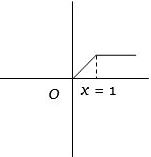
Clearly, from graph it is not differentiable at $x = 1.$

Need a full question paper?

Generate a complete, print-ready paper with questions like this in minutes — across 16+ boards, with answer keys.

Start Generating Free

Similar questions

If $A$ and $B$ are two sets, then $A \cup B = A \cap B$ iff
let $S = \{1, 2, … 20\}$. A subset $B$ of $S$ is said to be $“nice”$, if the sum of the elements of $B$ is $203$. Then the probability that a randomly chosen subset of $S$ is $‘nice’$ is
If $a = 2\,i + 2\,j + 3\,k,\,\,b = - i + 2\,j + k$ and $c = 3\,i + j,$ then $a + t\,b$ is perpendicular to $c$ if $t = $
If $a$ and $c$ are positive real numbers and the ellipse $\frac{{{x^2}}}{{4{c^2}}} + \frac{{{y^2}}}{{{c^2}}} = 1$ has four distinct points in common with the circle $x^2 + y^2 = 9a^2$ , then
Let $P = \left[ {\begin{array}{*{20}{c}}
  1&0&0 \\ 
  3&1&0 \\ 
  9&3&1 
\end{array}} \right]$ and $Q = [q_{ij}]$ be two $3\times3$ matrices such that $Q -P^5 = I_3$. Then $\frac{{{q_{21}} + {q_{31}}}}{{{q_{32}}}}$ is equal to
Let the foci of a hyperbola $H$ coincide with the foci of the ellipse $E: \frac{(x-1)^2}{100}+\frac{(y-1)^2}{75}=1$ and the eccentricity of the hyperbola $H$ be the reciprocal of the eccentricity of the ellipse $E.$ If the length of the transverse axis of $H$ is $\alpha$ and the length of its conjugate axis is $\beta$, then $3 \alpha^2+2 \beta^2$ is equal to $:$
A coin is tossed twice. If events $A$ and $B$ are defined as :$A =$ head on first toss, $B = $ head on second toss. Then the probability of $A \cup B = $
The value of $\int\limits_0^2 {\frac{{dx}}{{{{(1 - x)}^2}}}} $ is
Let â be a unit vector perpendicular to the vectors $\overrightarrow{ b }=\hat{ i }-2 \hat{ j }+3 \hat{ k }$ and $\overrightarrow{ c }=2 \hat{ i }+3 \hat{ j }-\hat{ k }$, and makes an angle of $\cos ^{-1}\left(-\frac{1}{3}\right)$ with the vector $\hat{ i }+\hat{ j }+\hat{ k }$. If $\hat{ a }$ makes an angle of $\frac{\pi}{3}$ with the vector $\hat{ i }+\alpha \hat{ j }+\hat{ k }$, then the value of $\alpha$ is :
The equation of the tangent to the parabola ${y^2} = 9x$ which goes through the point $(4, 10)$, is