MCQ
The function $f(x) = \max [(1 - x),\,(1 + x),\,2],$ $x \in ( - \infty ,\,\infty ),$ is
  • A
    Continuous at all points
  • B
    Differentiable at all points
  • Differentiable at all points except at $x = 1$ and $x =  - 1$
  • D
    Continuous at all points except at $x = 1$ and $x = - 1$ where it is discontinuous
Answer

Correct option: C.
Differentiable at all points except at $x = 1$ and $x =  - 1$
c
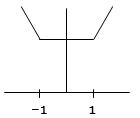
(a) $f(x) = \max \,\,\left\{ {(1 - x),\,\,(1 + x),\,\,2} \right\},\,\,\forall \,\,x \in ( - \,\infty ,\,\infty ).$

$f(x) = \left\{ {\begin{array}{*{20}{r}}{1 + x;}&{x > 1}\\{2;}&{ - 1 \le x \le 1}\\{1 - x;}&{x < - 1}\end{array}} \right.$

Since $f(x) = 1 - x$ or $1 + x$ are polynomial functions and $f(x) = 2$ is a constant function.

$\therefore$ These are continuous at all points.....$(i)$

$\therefore$ $f(x)$ is differentiable at all the points, except at

$x = 1$ and at $x = - 1$.....$(ii)$

Need a full question paper?

Generate a complete, print-ready paper with questions like this in minutes — across 16+ boards, with answer keys.

Start Generating Free

Similar questions

Area of circle $x^2+y^2=4$ :
If $\int {\frac{{{a^x}{e^{3x}}}}{{{b^x}{c^x}}}}$ $dx = \frac{1}{P}\left( {\frac{{{a^x}{e^{3x}}}}{{{b^x}{c^x}}}} \right) + K$; then $P =$  ??
$\int\limits^\pi_0\frac{1}{\text{a}+\text{b}\cos\text{x}}\text{ dx}=$

  1. $\frac{\pi}{\sqrt{\text{a}^2-\text{b}^2}}$

  2. $\frac{\pi}{\text{ab}}$

  3. $\frac{\pi}{\text{a}^2-\text{b}^2}$

  4. $({\text{a}+\text{b}})\pi$

If $A$ and $B$ are finite sets containing respectively $m$ and $n$ elements, then find the number of relation that can be defined from $A$ to $B$.
The existence of unique solution of the system of equations,  $x+y+z=\beta $ , $5x-y+\alpha z=10$ , $2x+3y-z=6$ depends on 
$\int_{}^{} {\frac{{{e^{2x}} - 1}}{{{e^{2x}} + 1}}} \;dx = $
Let $\vec{\text{a}},\vec{\text{b}},\vec{\text{c}}$ be three unit vectors, such that $\big|\vec{\text{a}}+\vec{\text{b}}+\vec{\text{c}}\big|=1$ and $\vec{\text{a}}$ is perpendicular to $\vec{\text{b}}.$ If $\vec{\text{c}}$ makes angle $\alpha$ and $\beta$ with $\vec{\text{a}}$ and $\vec{\text{b}}$ respectively, then $\cos\alpha+\cos\beta=$
  1. $-\frac{3}{2}$
  2. $\frac{3}{2}$
  3. $1$
  4. $-1$
Number of points of local maxima and minima of $f(x) = |x^2 - 2|x||$ in $R$, are $M$ and $m$ respectively, then value of $2M + m$ is -
There are two value of a which makes the determinant $\triangle=\begin{vmatrix}1&-2&5\\2&\text{a}&-1\\0&4&2\text{a}\end{vmatrix}$ equal to 86. The sum of these two values is:
  1. 4
  2. 5
  3. -4
  4. 9
The derivative of ${\sin ^2}x$ with respect to ${\cos ^2}x$ is