MCQ
The function $f(x) = {x^{ - x}},\,(x\, \in \,R)$ attains a maximum value at $x =$
  • A
    $x =  2$
  • B
    $x = 3$
  • $x = 1/e $
  • D
    $x = 1 $

Answer

Correct option: C.
$x = 1/e $
c
(c) $f(x) = y = {x^{ - x}}$ ==> $\log y = - \,x\log x$

Differentiating w.r.t.  $x$ , $\frac{1}{y}.\frac{{dy}}{{dx}} = - \left[ {x.\frac{1}{x} + \log x} \right]$

==> $\frac{1}{y}.\frac{{dy}}{{dx}} = - [1 + \log x]$ ==> $\frac{{dy}}{{dx}} = - {x^{ - x}}[1 + \log x]$

==> $\frac{{dy}}{{dx}} = {x^{ - x}}\left[ {\log \frac{1}{x} - 1} \right]$

Put $\frac{{dy}}{{dx}} = 0$ ==> ${\log _e}\frac{1}{x} = {\log _e}e$

==> $\frac{1}{x} = e \Rightarrow x = \frac{1}{e}$.

Need a full question paper?

Generate a complete, print-ready paper with questions like this in minutes — across 16+ boards, with answer keys.
Start Generating Free

Similar questions

The line $L$ given by  $\frac{{x - 2}}{2} = \frac{{y - 1}}{b} = \frac{{z + 1}}{c}$ passes through the point $(1, 2, 3)$ . Another line $K$ is parallel to line $L$ and has the equation $\frac{{x + 2}}{a} = \frac{{y - 3}}{2} = \frac{{z + 4}}{d}$ . Then the distance between line $L$ and $K$ is
Let $y=y(x)$ be the solution of the differential equation $\left(1+x^2\right) \frac{d y}{d x}+y=e^{\tan ^{-1} x}, y(1)=0$. Then $\mathrm{y}(0)$ is
The number of real values $\lambda$, such that the system of linear equations $2 x-3 y+5 z=9$  ;  $x+3 y-z=-18$    ; $3 x-y+\left(\lambda^{2}-1 \lambda \mid\right) z=16$ has no solution, is :-
One hundred identical coins each with probability $p$ of showing up heads are tossed once. If $0 < p < 1$ and the probability of heads showing on $50$ coins is equal to that of heads showing on $51$ coins, then the value of $p$ is
If the vectors  $a $ and $b$  are mutually perpendicular, then $a \times \{ a \times \{ a \times (a \times b)\} \} $ is equal to
Let $y=y(x)$ be the solution of the differential equation $x \log _e x \frac{d y}{d x}+y=x^2 \log _e x,(x > 1)$. If $y (2)=2$, then $y ( e )$ is equal to
If the function $f(x)=\frac{\cos (\sin x)-\cos x}{x^{4}}$ is continuous at each point in its domain and $f (0)=\frac{1}{ k },$ then $k$ is ........
$\int\limits_{ - 2}^\pi  {\frac{{{{\sin }^2}x}}{{\left[ {\frac{x}{\pi }} \right] + \frac{1}{2}}}} \,dx$ is equal to               (where $[·]$ denotes the greatest integer function)
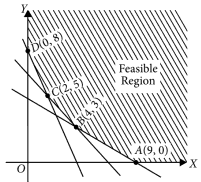
Feasible region for an L.P.P. is shown shaded in the following figure. Minimum of $Z=4 x+3 y$ occurs at the point
Image
Consider $f(x) = [x] + \sqrt {\left\{ X \right\}}$ where $[.]$ denotes greatest integer function and $\{.\}$ denotes fractional part function. Identify the correct statement-