MCQ
The function $f(x)=2 x+3(x)^{\frac{2}{3}}, x \in \mathbb{R}$, has
  • A
     exactly one point of local minima and no point of local maxima
  • B
    exactly one point of local maxima and no point of local minima
  •  exactly one point of local maxima and exactly one point of local minima
  • D
     exactly two points of local maxima and exactly one point of local minima

Answer

Correct option: C.
 exactly one point of local maxima and exactly one point of local minima
c
$ f(x)=2 x+3(x)^{\frac{2}{3}} $

$ f^{\prime}(x)=2+2 x^{\frac{-1}{3}} $

$ =2\left(1+\frac{1}{x^{\frac{1}{3}}}\right) $

$ =2\left(\frac{x^{\frac{1}{3}}+1}{x^{\frac{1}{3}}}\right) $

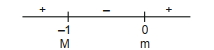
$ +\frac{1}{+}-\mathrm{m}^{-1}$

So, $\operatorname{maxima}(\mathrm{M})$ at $\mathrm{x}=-1$ $\operatorname{minima}(\mathrm{m})$ at $\mathrm{x}=0$

Need a full question paper?

Generate a complete, print-ready paper with questions like this in minutes — across 16+ boards, with answer keys.

Start Generating Free