MCQ
The function given by $y = | |x| - 1|$ is differentiable for all real numbers except the points
  • $\{0, 1, -1\}$
  • B
    $ \pm 1$
  • C
    $1$
  • D
    $-1$

Answer

Correct option: A.
$\{0, 1, -1\}$
a
$f(x)=|| x|-1|$ is non-differentiable when $|x|=0$ and when $|x|-1=\theta$ or $x=0$ and $\mathrm{x}=\pm 1.$

Alternative method:

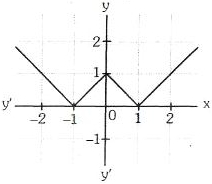
The graph of $y=|| x|-1|$ is as follows:

It has sharp turn at $x=-1,0$ and $1$ and hence, is not differentiable at $x=-1,0,1.$
Need a full question paper?

Generate a complete, print-ready paper with questions like this in minutes — across 16+ boards, with answer keys.

Start Generating Free

Similar questions

If $a,b,c$ are distinct and rational numbers then $\left| {\begin{array}{*{20}{c}}
{\left( {{a^2} + {b^2} + {c^2}} \right)}&{ab + bc + ca}&{ab + bc + ca}\\
{ab + bc + ca}&{\left( {{a^2} + {b^2} + {c^2}} \right)}&{\left( {bc + ca + ab} \right)}\\
{ab + bc + ca}&{\left( {ab + bc + ca} \right)}&{\left( {{a^2} + {b^2} + {c^2}} \right)}
\end{array}} \right|$ is always 
${d \over {dx}}\left[ {\left( {{{{{\tan }^2}2x - {{\tan }^2}x} \over {1 - {{\tan }^2}2x{{\tan }^2}x}}} \right)\cot 3x} \right] =$
Let $\mathrm{f}(\mathrm{x})$ be a polynomial of degree $5$ such that $\mathrm{x}=\pm 1$ are its critical points. $\mathop {\lim }\limits_{x \to 0} \left(2+\frac{f(x)}{x^{3}}\right)=4,$ then which one of the following is not true?
Evaluate: $\int\left(e^{x \log a}+e^{a \log x}+e^{a \log a}\right) d x$
$\int \frac{x}{\sqrt{x+4}} d x=$ __________ , $+ C , x >-4$.
$\int \frac{1}{e^x+1} d x=$ ___________ $+C$.
Let $f: R \rightarrow R$ be a function such that $f(x+y)=f(x)+f(y), \quad \forall x, y \in R .$ If $f(x)$ is differentiable at $x=0$, then

$(A)$ $f(x)$ is differentiable only in a finite interval containing zero

$(B)$ $f(x)$ is continuous $\forall x \in R$

$(C)$ $f^{\prime}(x)$ is constant $\forall x \in R$

$(D)$ $f(x)$ is differentiable except at finitely many points

If $\int_0^\pi {x\,f({{\cos }^2}x + {{\tan }^4}x)\,dx} $ $ = k\int_0^{\pi /2} {f({{\cos }^2}x + {{\tan }^4}x)\,dx,} $ then the value of $k$ is
Z = 4x1 + 5x2, subject to $2\text{x}_{1}+\text{x}_{2}\geq7,2\text{x}_{1}+3\text{x}2\leq15,\text{x}_{2}\leq3,\text{x}_{1},\text{x}_{2}\geq0.$ The minimum value of Z occurs at:
  1. (3.5, 0)
  2. (3, 3)
  3. (7.5, 0)
  4. (2, 3)
The value of $\int {\frac{{\log x}}{{{{(x + 1)}^2}}}dx} $ is