MCQ
The function ${\sin ^2}(\omega t)$ represents
  • A
    A simple harmonic motion with a period $2\pi /\omega $
  • B
    A simple harmonic motion with a period $\pi /\omega $
  • C
    A periodic but not simple harmonic motion with a period $2\pi /\omega $
  • A periodic but not simple harmonic, motion with a period $\pi /\omega $
Answer

Correct option: D.
A periodic but not simple harmonic, motion with a period $\pi /\omega $
d
(d) $y = {\sin ^2}\omega \,t$$ = \frac{{1 - \cos 2\omega t}}{2}$

==> Period,$T = \frac{{2\pi }}{{2\omega }} = \frac{\pi }{\omega }$

The given function is not satisfying the standard differential equation of $S.H.M.$

$\frac{{{d^2}y}}{{d{x^2}}} = - \,{\omega ^2}y$. Hence it represents periodic motion but not $S.H.M.$

Need a full question paper?

Generate a complete, print-ready paper with questions like this in minutes — across 16+ boards, with answer keys.

Start Generating Free

Similar questions

When the temperature of a rod increases from $t$ to $\left( {t + \Delta t} \right)$, its moment of inertia increases from $I$ to $\left( {I + \Delta I} \right)$. If $\alpha $ be the coefficient of linear expansion of the rod, then the value of $\left( {\frac{{\Delta I}}{I}} \right)$ is
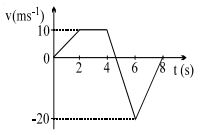
The figure shows a velocity-time graph of a particle moving along a straight line  The correct acceleration-time graph of the particle is shown as
Steel and copper wires of same length are stretched by the same weight one after the other. Young's modulus of steel and copper are $2 \times {10^{11}}\,N/{m^2}$ and $1.2 \times {10^{11}}\,N/{m^2}$. The ratio of increase in length
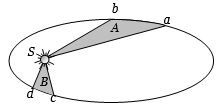
The figure shows the motion of a planet around the sun in an elliptical orbit with sun at the focus. The shaded areas $A$ and $B$ are also shown in the figure which can be assumed to be equal. If ${t_1}$ and ${t_2}$ represent the time for the planet to move from $a$ to $b$ and $d$ to $c$ respectively, then
If a given mass of gas occupies a volume of $10\, cc$ at $1$ atmospheric pressure and temperature of $100°C(373.15\, K).$ What will be its volume at 4 atmospheric pressure; the temperature being the same .... $cc$
A tuning fork of frequency $392 Hz,$ resonates with $50 cm $ length of a string under tension ($T$). If length of the string is decreased by $2\%$, keeping the tension constant, the number of beats heard when the string and the tuning fork made to vibrate simultaneously is
A solid sphere of radius $R$ and density $\rho$ is attached to one end of a mass-less spring of force constant $k$. The other end of the spring is connected to another solid sphere of radius $R$ and density $3 p$. The complete arrangement is placed in a liquid of density $2 p$ and is allowed to reach equilibrium. The correct statement$(s)$ is (are)

$(A)$ the net elongation of the spring is $\frac{4 \pi R^3 \rho g}{3 k}$

$(B)$ the net elongation of the spring is $\frac{8 \pi R^3 \rho g}{3 k}$

$(C)$ the light sphere is partially submerged.

$(D)$ the light sphere is completely submerged.

If $\mathrm{E}$ and $\mathrm{G}$ respectively denote energy and gravitational constant, then $\frac{\mathrm{E}}{\mathrm{G}}$ has the dimensions of :
The velocity- time graph of a body falling from rest under gravity and rebounding from a solid surface is represented by which of the following graphs?
A stretched string of length $l,$ fixed at both ends can sustain stationary waves of wavelength $\lambda ,$ given by