MCQ
The function $sin^2\,(\omega t)$ represents
  • A
    a periodic, but not simple harmonic, motion with a period $2\pi /\omega $
  • a periodic, but not simple harmonic, motion with a period $\pi /\omega $
  • C
    a simple harmonic motion with a period $2\pi /\omega $
  • D
    a simple harmonic motion with a period $\pi /\omega $
Answer

Correct option: B.
a periodic, but not simple harmonic, motion with a period $\pi /\omega $
b
The function $\sin ^{2}(\omega t)$ represents

a periodic, but not simple harmonic motion with a period $\frac{2 \pi}{\omega}$,

a simple harmonic motion with a period $\frac{\pi}{\omega}$

Need a full question paper?

Generate a complete, print-ready paper with questions like this in minutes — across 16+ boards, with answer keys.

Start Generating Free

Similar questions

If $I_1$ is the moment of inertia of a thin rod about an axis perpendicular to its length and passing through its centre of mass, and $I_2$ is the moment of inertia of the ring formed by bending the rod, then
Which types of vibration generated in gitar's wire:
A rod of length $10\ meter$ at $0\,^oC$ having expansion coefficient $\alpha  = (2x^2 + 1) \times  10^{-6}\,C^{-1}$ where $x$ is the distance from one end of rod. The length of rod at $10\,^oC$ is
The dimension of quantity $\frac{L}{RCV}$ is
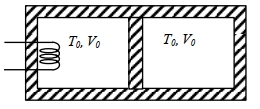
A thermally insulating cylinder has a thermally insulating and frictionless movable partition in the middle, as shown in the figure below. On each side of the partition, there is one mole of an ideal gas, with specific heat at constant volume, $C_v=2 R$. Here, $R$ is the gas constant. Initially, each side has a volume $V_0$ and temperature $T_0$. The left side has an electric heater, which is turned on at very low power to transfer heat $Q$ to the gas on the left side. As a result the partition moves slowly towards the right reducing the right side volume to $V_0 / 2$. Consequently, the gas temperatures on the left and the right sides become $T_L$ and $T_R$, respectively. Ignore the changes in the temperatures of the cylinder, heater and the partition.

($1$) The value of $\frac{T_R}{T_0}$ is

$(A)$ $\sqrt{2}$ $(B)$ $\sqrt{3}$ $(C)$ $2$ $(D)$ $3$

($2$) The value of $\frac{Q}{R T_0}$ is

$(A)$ $4(2 \sqrt{2}+1)$ $(B)$ $4(2 \sqrt{2}-1)$ $(C)$ $(5 \sqrt{2}+1)$ $(D)$ $(5 \sqrt{2}-1)$

Give the answer or qution ($1$) and ($2$)

A resistor of resistance R is connected to an ideal battery. If the value of R is decreased, the power dissipated in the resistor will:
  1. Increase.
  2. Decrease.
  3. Remain unchanged.
In uniform circular motion
We have half a bucket ($6$ litre) of water at $20^oC $.If we want water at $40^oC$, how much steam at $100^oC$ should be added to it ?
An inductor, a resistance and a capacitor are joined in series with an AC source. As the frequency of the source is slightly increased from a very low value, the reactance:
  1. Of the inductor increases.
  2. Of the resistor increases.
  3. Of the capacitor increases.
  4. Of the circuit increases.
The beats are produced by two sound sources of same amplitude and of nearly equal frequencies. The maximum intensity of beats will be ...... that of one source