MCQ
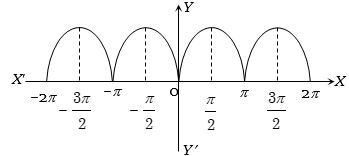
The function $y\, = \,|\sin x|$ is continuous for any $x$ but it is not differentiable at
  • A
    $x = 0$ only
  • B
    $x = \pi $ only
  • C
    $x = k\,\pi \,(k$ is an integer) only
  • $x = 0$ and $x = k\,\pi \,(k$ is an integer)
Answer

Correct option: D.
$x = 0$ and $x = k\,\pi \,(k$ is an integer)
d
(d) It can be easily seen from the graph of $f(x) = \,|\sin x|$ that it is every where continuous but not differentiable at integer multiples of $\pi $ and at $x = 0$.

Need a full question paper?

Generate a complete, print-ready paper with questions like this in minutes — across 16+ boards, with answer keys.

Start Generating Free

Similar questions

$\int_{\pi {\rm{/4}}}^{\pi {\rm{/2}}} {{e^x}(\log \sin x + \cot x)\,dx = } $
If $\tan^{-1}\Big\{\frac{\sqrt{1+\text{x}^2}-\sqrt{1-\text{x}^2}}{\sqrt{1+\text{x}^2}+\sqrt{1-\text{x}^2}}\Big\}=\alpha,$ then x2 =
  1. $\sin2\alpha$
  2. $\sin\alpha$
  3. $\cos2\alpha$
  4. $\cos\alpha$
The area bounded by the circle ${x^2} + {y^2} = 4,$ line $x = \sqrt 3 y$ and $x - $ axis lying in the first quadrant, is
If two events $A$ and $B$ are such that $P({A^c}) = 0.3,\,P(B) = 0.4$ and $P(A{B^c}) = 0.5,$ then $P[B/(A \cup {B^c})]$ is equal to
The value of a for which the function $\text{f(x)}=\begin{cases}5\text{x}-4,&\text{if }0<\text{x}\leq1\\4\text{x}^2+3\text{ax},&\text{if }<\text{x}<2\end{cases}$ is continuous at every point of its domain, is:
  1. $\frac{13}{3}$
  2. 1
  3. 0
  4. -1
If $A = \left\{ {1,2,3,......m} \right\},$ then total number of reflexive relations that can be defined from $A \to A$ is 
The value of the integral $\int_{ - \pi /4}^{\pi /4} {{{\sin }^{ - 4}}x} \,dx$ is
Let $f: R \rightarrow R$ and $g: R \rightarrow R$ be functions defined by

$f(x)=\left\{\begin{array}{cl}x|x| \sin \left(\frac{1}{x}\right), & x \neq 0, \\ 0, & x=0,\end{array}\right.$ and $g(x)=\left\{\begin{array}{cc}1-2 x, & 0 \leq x \leq \frac{1}{2}, \\ 0, & \text { otherwise }\end{array}\right.$

Let $a, b, c, d \in R$. Define the function $h: R \rightarrow R$ by

$h(x)=a f(x)+b\left(g(x)+g\left(\frac{1}{2}-x\right)\right)+c(x-g(x))+d g(x), x \in R$

Match each entry in $List-I$ to the correct entry in $List-II$.

$List-I$ $List-II$
($P$) If $a=0, b=1, c=0$ and $d=0$, then  ($1$) $h$ is one-one
($Q$) If $a=1, b=0, c=0$ and $d=0$, then  ($2$) $h$ is onto.
($R$) If $a=0, b=0, c=1$ and $d=0$, then  ($3$) $h$ is differentiable on $R$.
($S$) If $a=0, b=0, c=0$ and $d=1$, then ($4$) the range of $h$ is $[0,1]$
  ($5$) the range of $h$ is $\{0,1\}$

The correct option is

The differential equation of the family of curves, $x^{2}=4 b(y+b), b \in R,$ is
In a triangle $ABC ,$ if $|\overline{ BC }|=8,|\overline{ CA }|=7,|\overline{ AB }|=10,$ then the projection of the vector $\overline{ AB }$ on $\overline{ AC }$ is equal to ....... .