MCQ
The function$f(x) = [x]\cos \left[ {\frac{{2x - 1}}{2}} \right]\pi ,\,$ where$[.]$ denotes the greatest integer function, is discontinuous at
  • A
    All $x$
  • B
    No $x$
  • All integer points
  • D
    $x$ which is not an integer

Answer

Correct option: C.
All integer points
c
(c) $f(x) = [x]\cos \,\left[ {\frac{{2x - 1}}{2}} \right]\,\pi $

Since $g(x) = [x]$ is always discontinuous at all integral values of points. 

Hence $f(x)$ is discontinuous for all integral points.

Need a full question paper?

Generate a complete, print-ready paper with questions like this in minutes — across 16+ boards, with answer keys.

Start Generating Free

Similar questions

A bag contain 4 white and 2 black balls. Two balls are drawn at random. The probability that they are of the same colour is ________.
  1. $\frac{5}{7}$
  2. $\frac{1}{7}$
  3. $\frac{7}{15}$
  4. $\frac{1}{15}$
If $x + y - z = 0,\,3x - \alpha y - 3z = 0,\,\,x - 3y + z = 0$ has non zero solution, then $\alpha = $
The value of definite integral $\int\limits_\infty ^0 {\frac{{z\,{e^{ - z}}}}{{\sqrt {1 - {e^{ - 2z}}} }}\,dz} $.
The maximum value of the term independent of $'t'$ in the expansion of $\left( tx ^{\frac{1}{5}}+\frac{(1- x )^{\frac{1}{10}}}{ t }\right)^{10}$ where $x \in(0,1)$ is
A pack of playing cards was found to contain only 51 cards. If the first 13 cards which are examined are all red, then the probability thatthe missing card is black, is:

  1. $\frac13$

  2. $\frac23$

  3. $\frac12$

  4. $\frac{^{25}{\text{C}_{13}}}{^{51}{\text{C}_{13}}}$
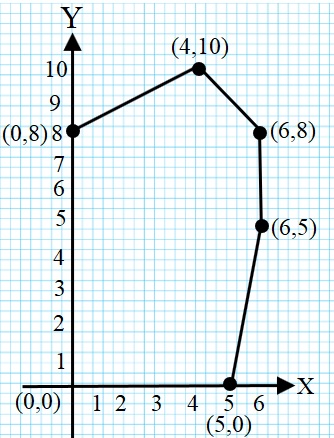
The feasible region for an LPP is shown below:

Let Z = 3x - 4y be the objective function. Minimum of Z occurs at

  1. (0, 0)
  2. (0, 8)
  3. (5, 0)
  4. (4, 10)
A bag contains $30$ white balls and $10$ red balls. $16$ balls are drawn one by one randomly from the bag with replacement. If $X$ be the number of white balls drawn, then $\left( {\frac{{{\rm{mean\, of\, X}}}}{{{\rm{standard\, deviation\, of\, X}}}}} \right)$ is equal to
If $\text{f(x)}=|\log_\text{e}|\text{x}||,$ then:
  1. f(x) is continuous and differentiable for all x in its domain.
  2. f(x) is continuous for all for all × in its domain but not differentiable at $\text{x}=\pm1$
  3. f(x) is neither continuous nor differentiable at $\text{x}=\pm1$
  4. None of these.
The magnitude of the vector 6i + 2j + 3k is equal to:
  1. 5
  2. 1
  3. 7
  4. 12
If $y = {{a + b{x^{3/2}}} \over {{x^{5/4}}}}$ and $y' = 0$ at $x = 5$, then the ratio $a:b$ is equal to