The fundamental note produced by a closed organ pipe is of frequency $f.$ The fundamental note produced by an open organ pipe of same length will be of frequency .... $(f)$
Easy
Download our app for free and get started
(c) ${n_{{\rm{closed}}}} = \frac{v}{{4l}},{n_{{\rm{open}}}} = \frac{v}{{2l}}$
==> ${n_{{\rm{open}}}} = 2{n_{{\rm{closed}}}} = 2f$

Download our appand get started for free
Experience the future of education. Simply download our apps or reach out to us for more information. Let's shape the future of learning together!No signup needed.*
Similar Questions
- 1A source emits a sound of frequency of $400 Hz$, but the listener hears it to be $390 Hz.$ ThenView Solution
- 2View SolutionStanding waves can be produced
- 3A student is performing an experiment using a resonance column and a tuning fork of frequency $244 s ^{-1}$. He is told that the air in the tube has been replaced by another gas (assume that the column remains filled with the gas). If the minimum height at which resonance occurs is $(0.350 \pm 0.005) m$, the gas in the tube isView Solution
(Useful information) : $\sqrt{167 R T}=640 j^{1 / 2} mole ^{-1 / 2} ; \sqrt{140 RT }=590 j ^{1 / 2} mole ^{-1 / 2}$. The molar masses $M$ in grams are given in the options. Take the value of $\sqrt{\frac{10}{ M }}$ for each gas as given there.)
- 4If the velocity of sound in air is $336 m/s$. The maximum length of a closed pipe that would produce a just audible sound will beView Solution
- 5View SolutionOne Mach number is equal to
- 6At which temperature the speed of sound in hydrogen will be same as that of speed of sound in oxygen at $100\,^oC$ ..... $^oC$View Solution
- 7Two open organ pipes of length $60 \mathrm{~cm}$ and $90 \mathrm{~cm}$ resonate at $6^{\text {th }}$ and $5^{\text {th }}$ harmonics respectively. The difference of frequencies for the given modes is . . . . . $\mathrm{Hz}$.View Solution
(Velocity of sound in air $=333 \mathrm{~m} / \mathrm{s}$ )
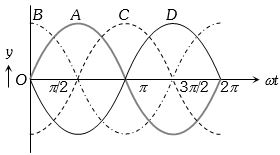
- 8The figure shows four progressive waves $A, B, C$ and $D $ with their phases expressed with respect to the wave $A$. It can be concluded from the figure thatView Solution
- 9A wire of density $9 \times 10^{-3} \,kg\, cm ^{-3}$ is stretched between two clamps $1\, m$ apart. The resulting strain in the wire is $4.9 \times 10^{-4}$. The lowest frequency of the transverse vibrations in the wire is......$HZ$View Solution
(Young's modulus of wire $Y =9 \times 10^{10}\, Nm ^{-2}$ ), (to the nearest integer),
- 10A source and an observer are moving towards each other with a speed equal to $\frac{v}{2}$ where $v$ is the speed of sound. The source is emitting sound of frequency $n$. The frequency heard by the observer will beView Solution