MCQ
The gas law $\frac{{PV}}{T} = $ constant is true for
  • A
    Isothermal changes only
  • B
    Adiabatic changes only
  • Both isothermal and adiabatic changes
  • D
    Neither isothermal nor adiabatic changes

Answer

Correct option: C.
Both isothermal and adiabatic changes
c
(c) For an ideal gas$:$

$P V=n R T$

$\frac{P V}{T}=n R=$ constant

Which is valid for all processes, which includes isothermal or adiabatic.

Hence option $\mathrm{C}$ is correct.

Need a full question paper?

Generate a complete, print-ready paper with questions like this in minutes — across 16+ boards, with answer keys.

Start Generating Free

Similar questions

A ball is projected from ground with a speed of $20\,m / s$ at an angle of $45^{\circ}$ with horizontal. There is a wall of $25\,m$ height at a distance of $10\,m$ from the projection point. The ball will hit the wall at a height of $.........\,m$
For a body moving with relativistic speed, if the velocity is doubled, then:
A couple is acting on a two particle systems. The resultant motion will be:
An open organ pipe of length $L$ vibrates in second harmonic mode. The pressure vibration is maximum
Two rods having thermal conductivity in the ratio of $5 : 3$ having equal lengths and equal cross-sectional area are joined by face to face. If the temperature of the free end of the first rod is $100°C$ and free end of the second rod is $20°C$ . Then temperature of the junction is...... $^oC$
A bat moving at $10\,ms^{-1}$ towards a wall sends a sound signal of $8000\,Hz$ towards it. On reflection it hears a sound of frequency $f$. The value of $f$ in $Hz$ is close to (speed of sound $= 320\,ms^{-1}$ )
The time period of an artificial satellite in a circular orbit of radius $R$ is $2\, days$ and its  orbital velocity is $v_0$. If time period of another satellite in a circular orbit is $16 \,days$ then
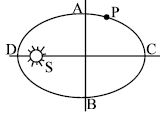
Figure shows the orbit of a planet $P$ round the sun $S.$ $AB$ and $CD$ are the minor and major axes of the ellipse.

If $U$ is the potential energy and $K$ kinetic energy then $|U| > |K|$ at
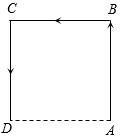
A particle moves along the sides $AB, BC, CD$ of a square of side $25 \,m$ with a velocity of $15$$m{s^{ - 1}}.$ Its average velocity is........$m{s^{ - 1}}$
Which is different from others by units